IndianSanskriti
Defence-Ministry-allows-purchase-of-7.40-lakh-assault-rifles-for-Armed-forces,-5,719-sniper-rifles-for-Army

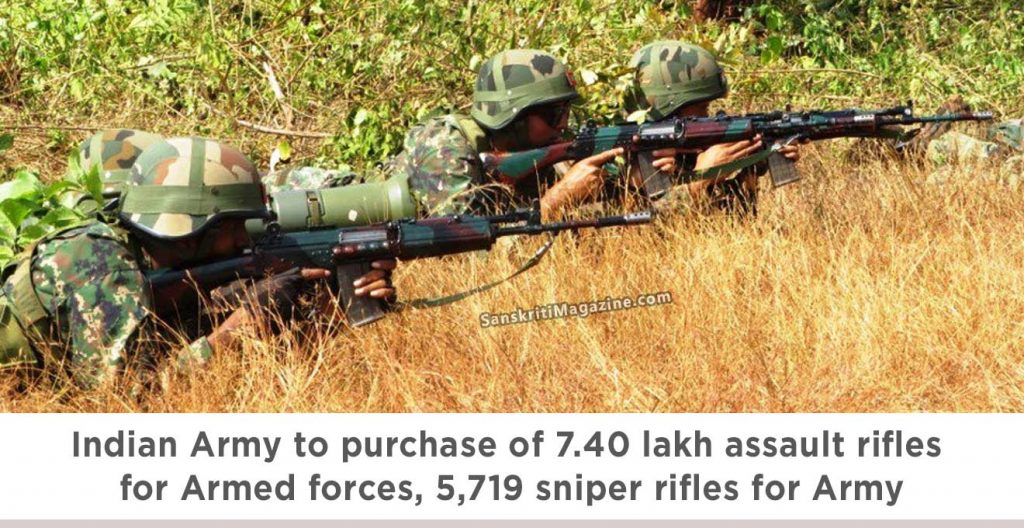
Indian Army to purchase of 7.40 lakh assault rifles for Armed forces, 5,719 sniper rifles for Army

The Indian Army has been pressing for fast-tracking of procurement of weapons considering the threats from bordering Pakistan and China.

NEW DELHI: The Defence Ministry has cleared the proposal to buy 7.40 lakh assault rifles for the three services and will also procure light machine guns worth Rs 1,819 crore. The Narendra Modi government has also cleared the proposal for the purchase of 5,719 sniper rifles for the Army at the cost of Rs 982 crore.

The Indian Army has been pressuring to fast-track the procurement of the weapons considering the threats from bordering Pakistan and China.

The long-pending proposals were cleared at a meeting of the Defence Acquisition Council (DAC), the defence ministry’s highest decision making body on procurement. The Defence Ministry said the DAC chaired by Defence Minister Nirmala Sitharaman cleared capital acquisition proposals which were valued at Rs 15,935 crore.

It said the DAC accorded approval for procurement of 7.4 lakh assault rifles for the three services at an estimated cost of Rs 12,280 crore.

The rifles will be produced in India under the ‘Buy and Make (Indian)’ category through both state-run Ordnance Factory Board and private sector.

In a statement, the ministry said “essential quantity” of Light Machine Guns (LMGs) will be through the “fast track” route at an estimated cost of over Rs 1,819 crore, primarily to meet the operational requirement of the troops deployed on the borders.

“A concurrent proposal is being processed for the balance quantity to be procured under the ‘Buy and Make (Indian)’ categorisation,” the ministry said.

The approval to the proposals come amid increasing hostilities by Pakistan along the Line of Control in Jammu and Kashmir as well as China’s aggressive posturing in several sectors along the nearly 4,000-km-long Sino-India border.

The Defence Acquisition Council (DAC) had in January 2018 cleared the procurement of 72,400 assault rifles and 93,895 carbines worth Rs 3,547 crores to meet an immediate requirement of the troops deployed along the borders. The DAC had simplified ‘Make-II’ procedure, which prescribes guidelines to be followed to develop and manufacture defence equipment through Indian industry.

Considering that no government funding is involved in ‘Make-II’ project, the DAC had simplified the procedure to make it industry-friendly, with minimal government control. The salient aspects of the revised procedure allow MoD to accept suo-moto proposals from the industry and also allow start-ups to develop equipment for the Indian Armed Forces. The minimum qualification criteria to participate in Make-II projects has also been relaxed by removing conditions related to credit rating and reducing financial net worth criteria.

(With PTI inputs)

You may also like

Search the website

Like us on Facebook

Get daily updates via Email

Enter your email address:

Recent Posts

Yogini Ekadashi 2026 — The Yaksha Who Missed the Morning Flowers, and the Ekadashi That Undid His Curse

On Friday, July 10, 2026, the rare Krishna Paksha Ekadashi of Nija Ashadha arrives. The Padma Purana tells the story of Hemamali — the Yaksha gardener of Bhagavan Kubera in Alaka, whose single morning of distraction with his wife Vishalakshi cost him his form, his wife, and his celestial city. Cursed to wander the earth of Bharata as a leper for a long time, he was at last shown the way back by Sage Markandeya — a single sincere keeping of Yogini Ekadashi.

Jamai Shashthi 2026 — The Story of Maa Shashthi, the Cat, and the Wife Who Was Forgiven

Jamai Shashthi 2026 — The Story of Maa Shashthi, the Cat, and the Wife Who Was Forgiven

On Saturday, June 20, 2026, Bengali households across Bharata will welcome their married daughters and sons-in-law home for the legendary jamai-aador feast and perform the Shashthi Vrata. But behind the warmth lies a story most Bengalis know by heart and most non-Bengalis have never heard — the wife who stole the hilsa, blamed the cat, lost six sons to Maa Shashthi’s wrath, and was finally forgiven. The Vrat Katha, the vidhi, the mantras, and the deeper teaching.

Vat Purnima 2026 — The Wife Who Argued Yama Into Returning Her Husband’s Life

On Monday, June 29, 2026, women across Maharashtra, Gujarat, and southern Bharata will tie red thread around banyan trees and hear the story of Savitri — the wife who walked behind Yamaraja Himself when He came for her husband, and out-argued the Lord of Dharma into returning Satyavan’s life. The Mahabharata’s Pativrata Mahatmya Parva, the vrat vidhi, and why the banyan witnessed everything.

Nija Jyeshtha 2026 — The Real Jyeshtha Begins, and the Calendar Resumes

Nija Jyeshtha 2026 — The Real Jyeshtha Begins, and the Calendar Resumes

With Adhik Maas now closed on the Somvati Amavasya of June 15, the long-postponed festivals of Jyeshtha return — Vat Purnima (June 29, the Savitri-Yamaraja katha), Jamai Shashthi (June 20, the Bengali festival of Maa Shashthi), Sankashti Chaturthi (June 28), Yogini Ekadashi (July 10), and Devshayani Ekadashi (July 16, opening the four-month Chaturmas of Bhagavan Vishnu’s yoga-nidra). A guide to what the next four weeks hold and what the household that kept Purushottam Maas now carries forward.

The Closing of Purushottam Maas 2026 — Adhik Amavasya and the Sealing of the Month-Long Vrat

On Monday, June 15, 2026 — a rare Somvati Amavasya — the intercalary month that bears Bhagavan Vishnu’s own name comes to its close. The Acharyas teach that a vrat is not measured by its duration but by its closing. Here are the Padma Purana’s instructions for sealing the month-long Purushottam Maas vrat: the morning snan, the closing puja with the Vishnu Sahasranama, the day of dana, the Somvati Amavasya gift, and the final sarva-arpana — the offering of all merit at the feet of the Lord.

css.php