IndianSanskriti
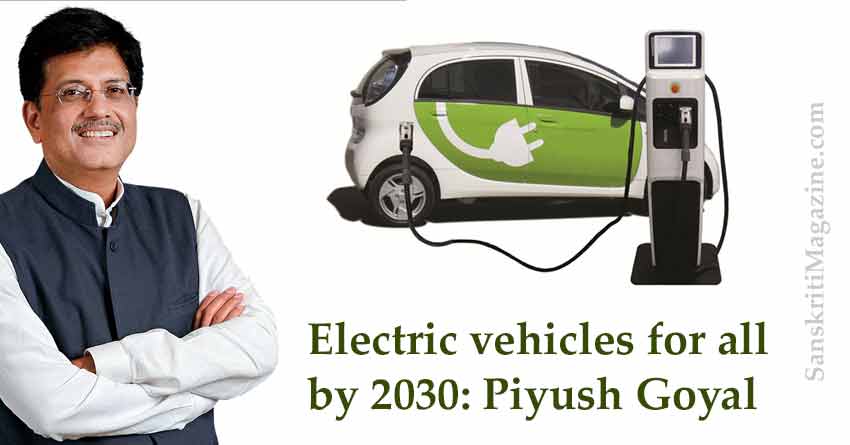
Electric vehicles for all by 2030: Piyush Goyal

India to become 100% e-vehicle nation by 2030: Piyush Goyal

New Delhi: Come 2030, and every car user in the country could have an electric vehicle. That’s the goal that the government is working towards, said minister for power, coal, new and renewable energy Piyush Goyal.

Under the plan, the vehicles will be given without an upfront payment and will be paid for by users over a period of time from the savings made on fuel, he added.

The idea is inspired by the success of the government’s campaign to promote energy-efficient LED bulbs, which has seen costs falling by 80% over 18 months to Rs.99 per bulb now.

Power utilities distribute these bulbs and consumers pay for them over a period of time from the savings in their power bills.

“We have created a working group under the leadership of road transport and highways minister Nitin Gadkari, who is good at coming up with large-scale programmes. Environment minister Prakash Javadekar, petroleum minister Dharmendra Pradhan and I are members of this group. We will meet in the first week of April to see if India can 100% be on electric vehicles by 2030,” Goyal said at the Conference on Young Indians organized by industry lobby Confederation of Indian Industry on Saturday.

The automobile industry welcomed the move. “It is a great, workable model. Promoting electric or hybrid cars through innovative schemes can reduce vehicular pollution, reduce fossil fuel dependence and will be beneficial for the consumer. We will work with the government on this,” said Vishnu Mathur, director general of industry lobby Society of Indian Automobile Manufacturers (SIAM).

India’s automobile industry is the sixth largest in the world and accounts for 22% of the country’s total manufacturing output.

The sector is a vital component of the government’s plan to raise the share of manufacturing in the country’s gross domestic product (GDP) from about 15% now to 25% by 2022.

Goyal said the idea was to make the programme entirely self-financing without any assistance from the government. “We do not need even one paisa from the government or the people. We will see if we can give electric cars for free and monetize the savings you can have (from not using fossil fuels) and pay for the vehicles” he said.

India now consumes 19 million tonnes of petrol and 69 million tonnes of diesel a year, according to Petroleum, Planning and Analysis Cell, under the oil ministry. The country also exports 16 million tonnes of petrol and 25.5 million tonnes of diesel every year. A decline in domestic consumption will leave refineries with more to export.

“We have not yet decided who will manufacture these vehicles and where. We are thinking of scale and of leading the world rather than following the world. India will be the first country to think on such a scale,” said Goyal.

Mathur said that achieving scale can help in promoting localization of cutting edge components as well as local development of technology.

You may also like

Search the website

Like us on Facebook

Get daily updates via Email

Enter your email address:

Recent Posts

Yogini Ekadashi 2026 — The Yaksha Who Missed the Morning Flowers, and the Ekadashi That Undid His Curse

On Friday, July 10, 2026, the rare Krishna Paksha Ekadashi of Nija Ashadha arrives. The Padma Purana tells the story of Hemamali — the Yaksha gardener of Bhagavan Kubera in Alaka, whose single morning of distraction with his wife Vishalakshi cost him his form, his wife, and his celestial city. Cursed to wander the earth of Bharata as a leper for a long time, he was at last shown the way back by Sage Markandeya — a single sincere keeping of Yogini Ekadashi.

Jamai Shashthi 2026 — The Story of Maa Shashthi, the Cat, and the Wife Who Was Forgiven

Jamai Shashthi 2026 — The Story of Maa Shashthi, the Cat, and the Wife Who Was Forgiven

On Saturday, June 20, 2026, Bengali households across Bharata will welcome their married daughters and sons-in-law home for the legendary jamai-aador feast and perform the Shashthi Vrata. But behind the warmth lies a story most Bengalis know by heart and most non-Bengalis have never heard — the wife who stole the hilsa, blamed the cat, lost six sons to Maa Shashthi’s wrath, and was finally forgiven. The Vrat Katha, the vidhi, the mantras, and the deeper teaching.

Vat Purnima 2026 — The Wife Who Argued Yama Into Returning Her Husband’s Life

On Monday, June 29, 2026, women across Maharashtra, Gujarat, and southern Bharata will tie red thread around banyan trees and hear the story of Savitri — the wife who walked behind Yamaraja Himself when He came for her husband, and out-argued the Lord of Dharma into returning Satyavan’s life. The Mahabharata’s Pativrata Mahatmya Parva, the vrat vidhi, and why the banyan witnessed everything.

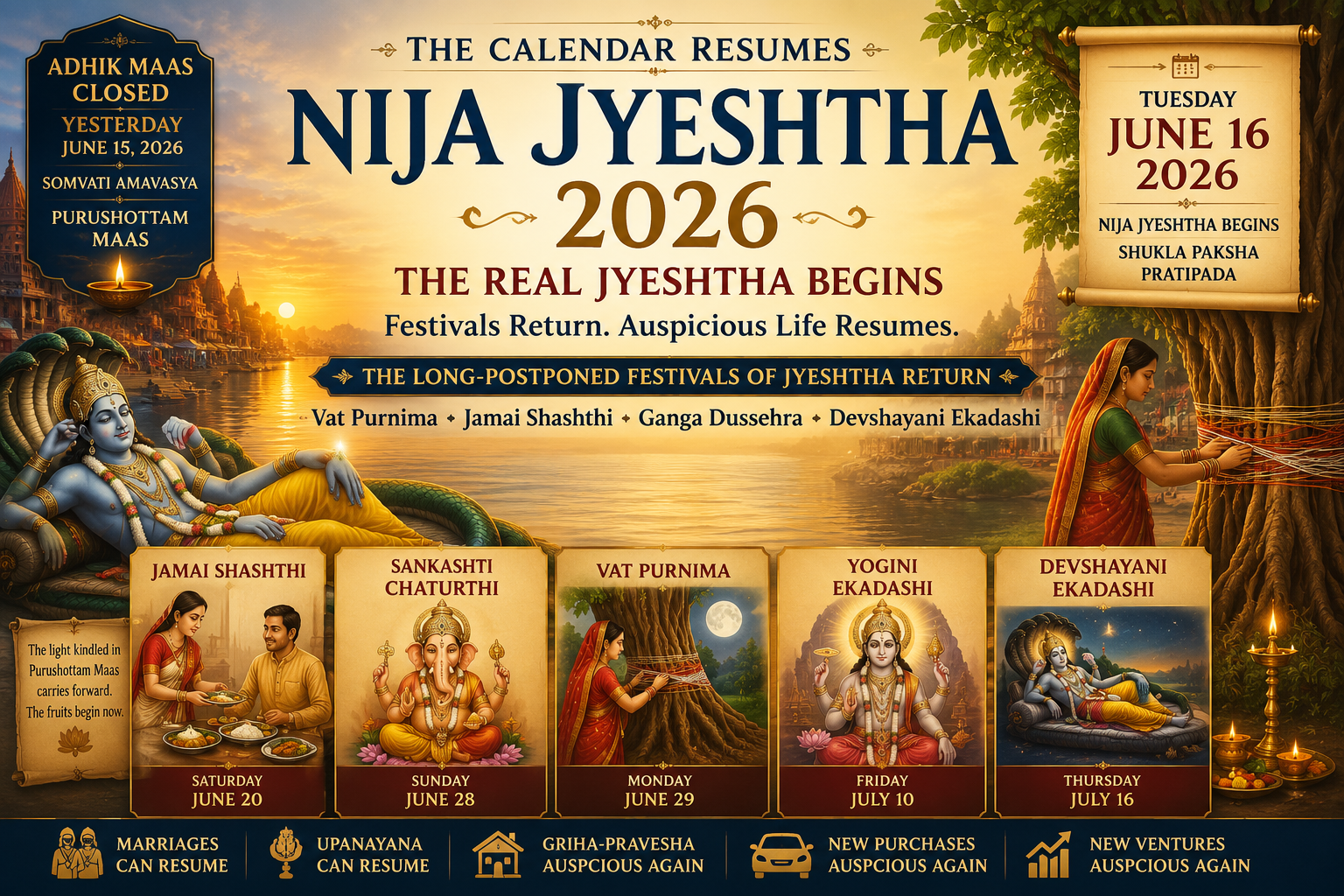
Nija Jyeshtha 2026 — The Real Jyeshtha Begins, and the Calendar Resumes

Nija Jyeshtha 2026 — The Real Jyeshtha Begins, and the Calendar Resumes

With Adhik Maas now closed on the Somvati Amavasya of June 15, the long-postponed festivals of Jyeshtha return — Vat Purnima (June 29, the Savitri-Yamaraja katha), Jamai Shashthi (June 20, the Bengali festival of Maa Shashthi), Sankashti Chaturthi (June 28), Yogini Ekadashi (July 10), and Devshayani Ekadashi (July 16, opening the four-month Chaturmas of Bhagavan Vishnu’s yoga-nidra). A guide to what the next four weeks hold and what the household that kept Purushottam Maas now carries forward.

The Closing of Purushottam Maas 2026 — Adhik Amavasya and the Sealing of the Month-Long Vrat

On Monday, June 15, 2026 — a rare Somvati Amavasya — the intercalary month that bears Bhagavan Vishnu’s own name comes to its close. The Acharyas teach that a vrat is not measured by its duration but by its closing. Here are the Padma Purana’s instructions for sealing the month-long Purushottam Maas vrat: the morning snan, the closing puja with the Vishnu Sahasranama, the day of dana, the Somvati Amavasya gift, and the final sarva-arpana — the offering of all merit at the feet of the Lord.

css.php