IndianSanskriti

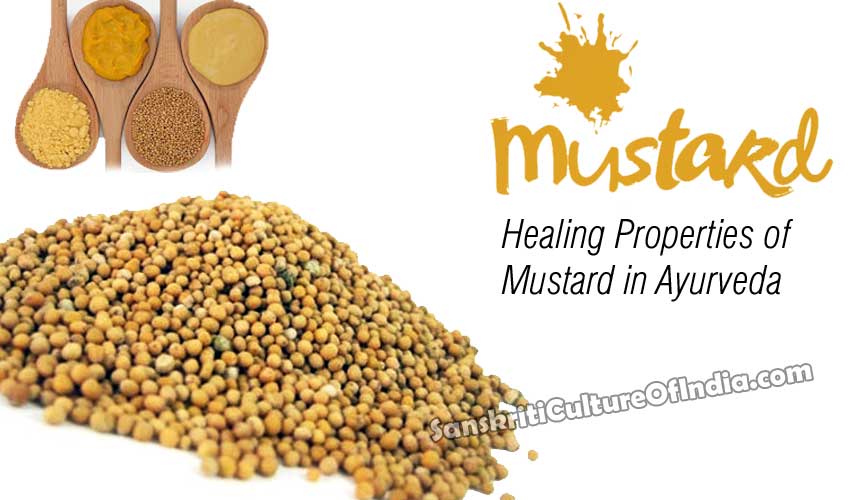
Healing Properties of Mustard in Ayurveda

.

Mustard in Ayurveda

Mustard or Rai is an annual plant cultivated as a spice all over the world. It has been used for centuries as a pungent condiment and healing herb by the Chinese, the Greeks and the Ayurvedics. Mustard is peculiar in that its strong taste develops only after the seeds are crushed and come into contact with water or saliva.

Properties:

Mustard is an antiseptic, warming, carminative, antibacterial and antiviral. It aids in digestion and eases gastric distention. It is an emetic, rubefacient, and a laxative. It acts as an irritant, encouraging blood flow toward the surface of the skin in cases of rheumatism, sciatica, peritonitis and neuralgia and for various muscle aches and pains. From the whole plant, only the seeds and pods are used.

Conditions Treated:

For centuries, mustard plasters have been used to treat chest colds and coughs. Mustard is also beneficial for backache, joint pain, digestive upsets, hiccups and as a laxative. Mustard eases constipation, minor aches and pains and muscle stiffness. It is used either as a spice or oil, in compresses and poultices. It can also be used along with aloe vera, ginger, garlic and onion. Poultices should be used only for 10-15 minutes at a time or blistering and irritation can occur.

Methods of Use:

Mustard reduces pitta and kapha, and has a neutral effect on vatta.

Mustard oil can be rectified with alcohol (1 part oil to 40 parts alcohol) and used as a lotion for joint pains, arthritis and sluggish circulation.

A mustard foot bath will clear blood congestion in the head, warm up cold feet and lower a fever in the early stages of illness. Put one-quarter of a cup of mustard seed in a small cloth bag or a large tea strainer. Steep in hot water for 5 minutes and soak feet until the water cools off.
p>
You may also like

Search the website

Like us on Facebook

Get daily updates via Email

Enter your email address:

Recent Posts

Padmini Ekadashi 2026 — The Ekadashi Even the Devas Descend to Keep

Padmini Ekadashi 2026 — The Ekadashi Even the Devas Descend to Keep

The rarest Ekadashi of the entire Hindu calendar is three days away. The Padma Purana preserves a conversation between Bhagavan Krishna and Yudhishthira about a single Ekadashi the great Rishis spend lifetimes waiting for — Padmini. The Vrat Katha of Queen Padmini of Mahishmati, the lotus teaching, and why May 27, 2026 is the morning Vaishnavas across Bharata are preparing for.

Varada Chaturthi 2026 — The Rare Ganesha Day of Purushottam Maas

Varada Chaturthi 2026 — The Rare Ganesha Day of Purushottam Maas

Once every 2.5–3 years — when the rare 13th month of Adhika Maas opens — a thirteenth Vinayaka Chaturthi appears. The Mudgala Purana calls it Varada Chaturthi, the “boon-giving” Chaturthi, and holds it as the most fruit-bearing Ganesha day of the entire calendar. Today, Wednesday May 20, 2026, is that day.

Padmini Ekadashi 2026 — The Rare Ekadashi That Comes Only in Purushottam Maas

Padmini Ekadashi 2026 — The Rare Ekadashi That Comes Only in Purushottam Maas

Padmini Ekadashi 2026 falls on Wednesday, May 27 — the Shukla Paksha Ekadashi of Adhika Maas, the rarest Ekadashi in the entire Hindu calendar (it appears only every 2.5–3 years). The Padma Purana conversation between Bhagavan Krishna and Yudhishthira, the Vrat Katha of Queen Padmini, complete vrat vidhi with jagrana, mantras, and the lotus symbolism that gives the Ekadashi its name.

Ganga Dussehra 2026 — The Day Maa Ganga Came Down to Bhagiratha

Ganga Dussehra falls on Monday, May 25, 2026 — commemorating the day Maa Ganga descended from Vaikuntha to the earth through the millennia-long tapasya of King Bhagiratha. The full account from the Valmiki Ramayana, snan vidhi, dana traditions, mantras, and the teaching of sustained sincerity.

Adhik Jyeshtha Maas 2026 — The Hidden Month That Belongs to Lord Vishnu

Once every 2.5–3 years, the Hindu calendar opens a quiet thirteenth chamber — the intercalary month Lord Vishnu took for His own. A Puranic look at Adhik Jyeshtha Maas 2026 (May 2–31), the Padma Purana account of how it became Purushottam Maas, and a complete householder’s guide for its closing days.

css.php