The situation around the Kurukshetra war was such that no one could remain neutral. You had to choose one side. Being the chief of the Yadavas, Krishna also had to put his lot either with the Pandavas or the Kauravas. Personally, he did not want this war and would have preferred to remain neutral, but that was not possible. He had no hatred against Hastinapur. He did not just choose Duryodhana; Bhisma, Dronacharya, Kripacharya – many venerable leaders were on the other side. He was not against them, and they had huge respect for him too. Both with Duryodhana and with the Pandavas, there was a distant blood relationship.
When a relative comes and asks your help, a “no” would be difficult according to the Kshatriya dharma.
There was Kshatra Tej, the dharma for the warrior class, and Brahma Tej for the spiritual class. Krishna tried to bring about some kind of alliance between the Kshatriyas and the Brahmins. These guidelines and rules were created for the society to function smoothly. They said, a Brahmin must sit and study the Vedas for a certain number of hours a day. If the same dharma was enforced on a Kshatriya, he may not be competent to do it, and if he did this, he would not be a good administrator and definitely not a good warrior. The same goes for all the other classes. That is why they established different types of dharmas for different categories of people who had different duties to perform in the society.
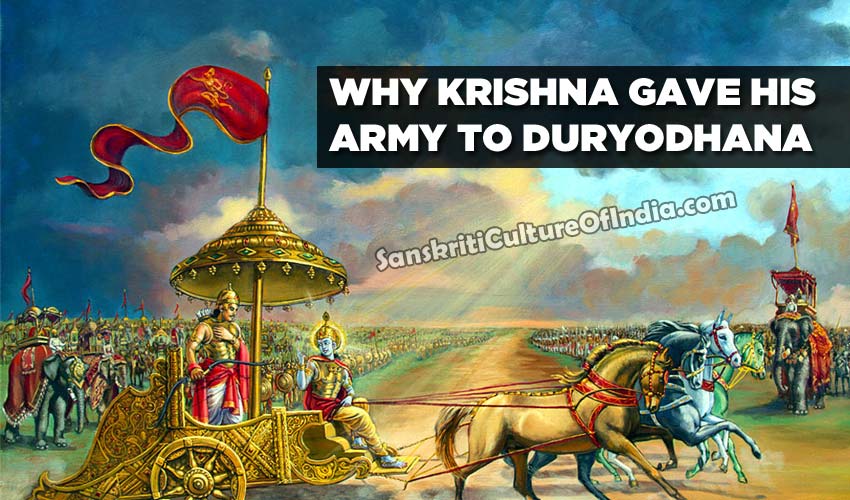
But at some point, the Kshatriyas started thinking only in terms of what is good for them and their dharma without considering all the others and their dharmas, which disturbed the harmony in the society. Krishna and Vyasamuni strived to bring Kshatra Tej and Brahma Tej closer together so they could function as a cohesive force for the benefit of all. Since according to the Kshatra Tej, when a relative comes and asks for something, you cannot say “no,” Krishna gave them the choice between himself and his army. From a military standpoint, an army is definitely the better choice. Duryodhana believed that taking the army was sensible, though he did not get the first choice and was perturbed about that. When given the choice, the Pandavas had said to Krishna, “Whether we live or die – if we live, we want to live with you. If we die, we want to die with you. Without you, what will we do?” And that is what made the difference for them.
Now, your question is, “If Krishna is standing for dharma, how can he put his armed might on the side of adharma?” He was not a moralistic person who made black-and-white judgments about anyone. He neither believed the Pandavas were absolutely pure beings, nor that the Kauravas were absolute evil. This was not the way he looked at life. He constantly maintained a good relationship with the Kauravas. Duryodhana’s wife Banumathi was a devotee of his. He did not see the Kauravas as out and out evil – he just saw that they were causing much evil at that time and he would have liked to put an end to that. This does not mean he held any kind of hatred or anger against them, nor did he judge them as evil. He saw that human beings are always a combination of everything. That is why you have to strive to establish dharma within yourself; otherwise, you will become adharma.
Any human being is capable of becoming adharma any moment of his life. There is no insurance that you will never fall into adharma. You have to strive to be aware; you have to strive to be on the righteous path, or else you will easily slip off. This goes for every human being, until you attain to such a level of consciousness where you cannot fall anymore.
In many ways, Krishna tried to encourage Duryodhana to strive for dharma. Even at that point when he gave this choice between him and his army, he still tried to avoid the war. In a way, it was a very intelligent move to give the army to Duryodhana. That way, Duryodhana felt that “Krishna is on my side,” thinking the Pandavas were fools to take one person instead of a 100,000-man-strong army. This could have been something for Duryodhana to latch on to and bring peace, but it failed.
~ Sadhguru Jaggi Vasudev