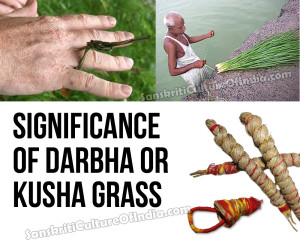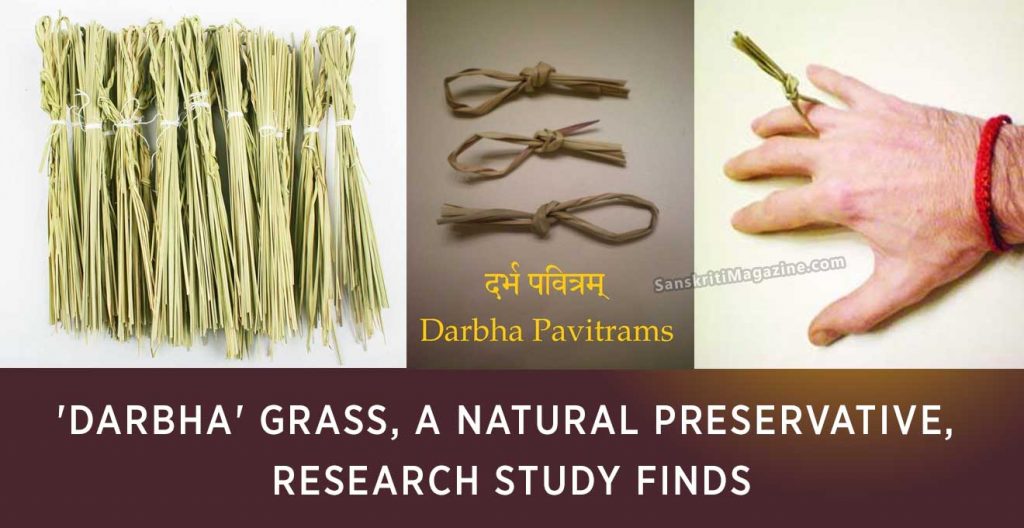
Darbha (Desmotachya bipinnata) is a tropical grass considered a sacred material in Vedic scriptures and is said to purify the offerings during such rituals.
Traditional tropical grass, Darbha, has been identified as an eco-friendly food preservative.
This finding was evolved in a research study undertaken jointly by the Centre for Nanotechnology and Advanced Biomaterials (CeNTAB) and the Centre for Advanced Research in Indian System of Medicine (CARISM) of the SASTRA University, Thanjavur, under the supervision of Dr. P. Meera and Dr. P. Brindha respectively.
Darbha (Desmotachya bipinnata) is a tropical grass considered a sacred material in Vedic scriptures and is said to purify the offerings during such rituals.
At the time of eclipse, people place that grass in food items that could ferment and once the eclipse ends the grass is removed.
A systematic research was conducted by the SASTRA University researchers, in which cow’s curd was chosen as a food item that could ferment easily.
Five other tropical grass species, including lemon grass, Bermuda grass, and bamboo were chosen for comparison based on different levels of antibiotic properties and hydro phobicity.
Electron microscopy of different grasses revealed stunning nano-patterns and hierarchical nano or micro structures in darbha grass while they were absent in other grasses.
On studying the effect of various grasses on the microbial community of the curd, darbha grass alone was found to attract enormous number of bacteria into the hierarchical surface features.
These are the bacteria responsible for fermentation of cow’s curd.
During eclipse, the wavelength and intensity of light radiations available on the earth’s surface is altered. Especially, the blue and ultraviolet radiations, which are known for their natural disinfecting property, are not available in sufficient quantities during eclipse.
This leads to uncontrolled growth of micro-organisms in food products during eclipse and the food products are not suitable for consumption. Darbha was thus used as a natural disinfectant on specific occasions, say researchers at SASTRA University.
Further, the scientists say that darbha could be used as a natural food preservative in place of harmful chemical preservatives and the artificial surfaces mimicking the hierarchical nano patterns on the surface of darbha grass could find applications in health care where sterile conditions were required.
This entire research was funded by the SASTRA University’s Research Fund.