IndianSanskriti
The Curse of Rishi Gautama From Varaha Purana

The Curse of Rishi Gautama From Varaha Purana

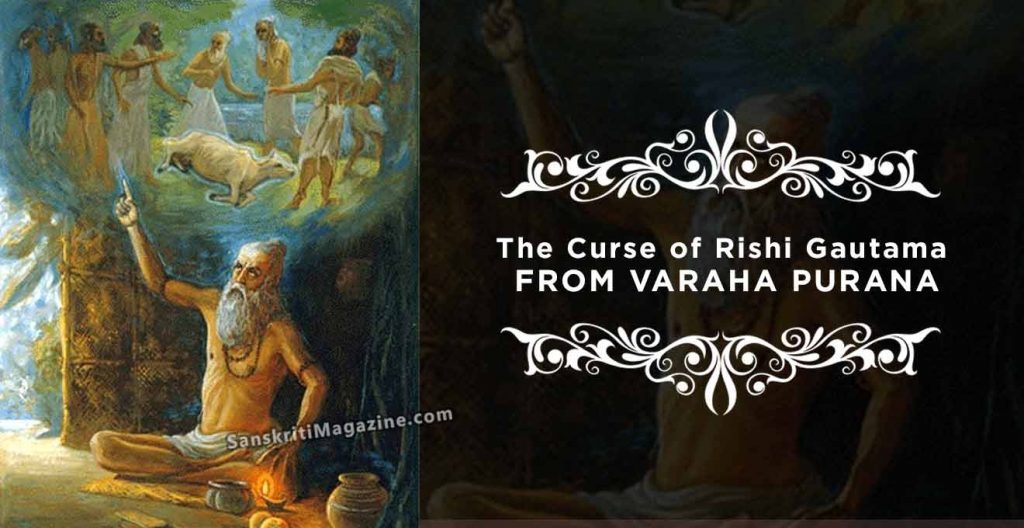
Gautama’s curse on the brahmanas who wished to leave, creating a deception as an excuse to do so. From Varaha Purana.

In ancient times, the sage Gautama performed austerities in Dandakaranya forest. Lord Brahma became pleased and gave him some divine seeds capable of producing eternal crops. Gautama then went to Saptasring mountain and made his hermitage there. He sowed the seeds and was very pleased to see rice grains sprouting up within moments. Gautama lived there happily with his disciples. In due course of time, the whole country was plagued by a great famine — everywhere except at the hermitage of Gautama.

One day, a few sages arrived at Gautama’s hermitage, and he treated them with all respect. These sages enjoyed the hospitality of Gautama, staying at his hermitage and engaging in long discussions with him, until eventually the famine was over. Then they decided to go back to their respective native places. When they sought Gautama’s permission, he requested them to stay for a few more days.

The sages then decided to use deceitful means for taking their leave of Gautama’s association. They created a superficial cow with the help of their illusionary powers and left it near the hermitage of Gautama.

Gautama was very pleased to see that cow. He eulogised it by sprinkling water on it. Hardly had he finished his act than the cow died. All the deceitful sages then returned to the scene, and cursed Gautama for killing an innocent cow. They told him that they could never live along with a person who had killed a cow, and on this excuse, they took their leave, just as they had meant to do all along.

Gautama then strictly observed the prescribed atonement for such an inauspicious act as killing a cow. Afterwards he discovered that the cow had simply been an illusion created by the brahmanas as part of their deception. He angrily cursed them to lose their Vedic knowledge. In this way, knowledge turned to ignorance.


You may also like

Search the website

Like us on Facebook

Get daily updates via Email

Enter your email address:

Recent Posts

Adi Shankaracharya Jayanti 2026 — Advaita Vedanta, Om symbol, and four Amnaya Peethas

Adi Shankaracharya — The Monk Who Reunited Bharata

Shankaracharya Jayanti 2026 — the 1238th birth anniversary of Adi Shankaracharya. His extraordinary life, the Digvijaya, the debate with Mandana Mishra, Advaita Vedanta, the four Amnaya Peethas, and his timeless literary legacy.

Akshaya Tritiya 2026 — royal purple hero banner with Akshaya Patra vessel and Devanagari text

Akshaya Tritiya 2026 — The Day That Never Diminishes

Akshaya Tritiya (April 19, 2026) is one of the most auspicious days in the Vedic calendar — when any act of dharma, dana, or japa yields imperishable merit. Discover the five sacred Puranic events, complete puja vidhi, timings, mantras, and the deeper spiritual teaching beyond gold-buying.

Baisakhi 2026 — Mesha Sankranti Hindu Solar New Year hero banner with rising sun, Om symbol and wheat harvest

Baisakhi 2026 — Harvest, Hope, and the Hindu Solar New Year

Baisakhi 2026 falls on Tuesday, April 14 — the day Bhagavan Surya enters Mesha Rashi at 9:39 AM, marking the Hindu Solar New Year. Discover the sacred science of Mesha Sankranti, the Punya Kaal rituals, and how this one cosmic moment is celebrated across Bharata as Vishu, Puthandu, Pohela Boishakh, Bohag Bihu, and Pana Sankranti.

Varuthini Ekadashi 2026 — sacred vrat guide hero banner with Vishnu Chakra mandala

Varuthini Ekadashi 2026 — The Sacred Vrat That Shields from Sin

Varuthini Ekadashi (April 13, 2026) is one of the most powerful Ekadashi vrats — dedicated to Lord Vamana, it dissolves lifetimes of karmic burden and shields the devoted soul with Bhagavan Vishnu’s protective grace. Complete vrat vidhi, timings, mantra, and the sacred Vrat Katha from the Bhavishya Purana.

css.php