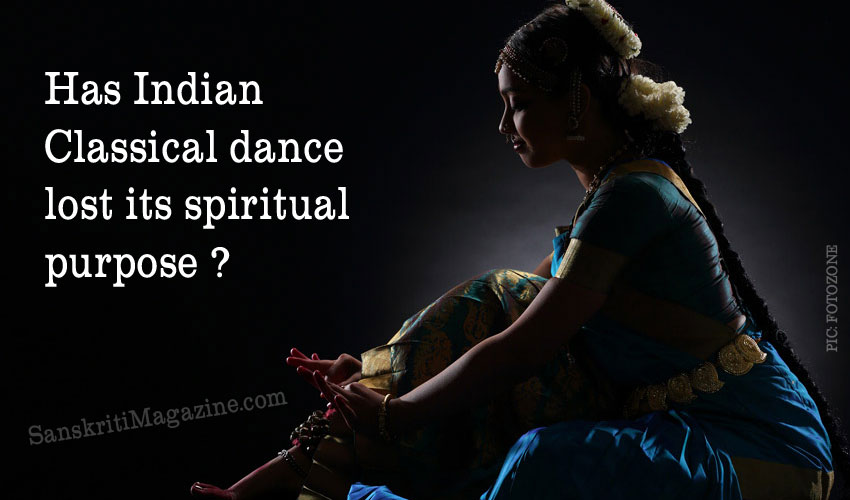
There is much to say about the Indian classical dances about its lucidity, expression, etc. Yet many and most of our dancers forget why they are dancing and for what purpose they are dancing. The competition for performing, the glamour, commercialism, image, fame and all that nonsense has cropped into the dances since fifty years back when it was first brought from the temple.
A dance like ours containing divine and Godly verses does not need people like critics to judge a dancer. Any dancer, whether they are veterans or superstars or a learner should be treated with equal respect as an expression of divine.
Many dancers cling frantically to an organization and the organizers in order to get performance opportunities. In return they are expect to promote these organizations and bring up the organization’s image in the name of dance; thereby contributing to politics, rivalry between organizations, you name it. Then there are those who run after reporters to make sure a dancer is publicized in the paper – all in the name of our spiritual art. Such attitude creates separation between humans because of the ego. The main point is whether one has transformed after seeing or dancing about the divine. For the purpose of the dance is not to show oneself but to express the divine – that should be reflected in the dancer’s outlook in life.
Sometimes I wonder whether devadasis in the past have all this in mind when they dance before their Lord. No. They had only one aim – to dance before the Lord in the temple, and that too with no audience looking on. They did not even need music – for they themselves used to sing while dancing padams (loves songs of the Lord). It was just the dancer and the Lord. The devadasi’s dance must be of a very high order of divine quality when compared to most of what we see today which is mostly dramatic and showmanship. For me, the most beautiful and divine experience of dance is not in any organization, festival, or country, but in front of the Lord in Shiva’s temple in Chidambaram in the annual Shivaratri. I am not even talking about performing before the thousands at the annual Shivaratri. I mean prior to that when curtain of the statue of Nataraja is unveiled and one gets a glimpse of the Lord and dance in front of him! That too was only five minutes for me.
The dance we see today is quite far from the spiritual level of the dance in the past. There is a big gap in the creativity of composers, musicians, dancers between now and the past. One could see that the dance has evolved from the Vedic ages to the Tanjore Quartet repertoire created two hundred years ago. Yet we are still seeing the Tanjore Quartet repertoire without any further improvisation or development. Any further development has not been seen as successful as when compared to the grandeur and creative genius of Tanjore Quartet times.
There were a lot of exchange and interaction in the olden days in dance and music according to “Bharatanatyam – A Tamil heritage” written by Lakshmi Viswanathan. Sadly, what we see nowadays is arrogance between dance practitioners that there is hardly any progress in the dance at least back to the level of what our ancestors left for us.
One can easily see the guru-shishya parampara is virtually non-existent these days. What is left now is the training with performers who are themselves globe-trotters having little time for students. Seeing the glamour in their teachers, these students grow up learning the “tricks of the trade”. They want to be on stage one day performing to hundreds or thousands of people whatever you name it. Then tour round the globe and picking up titles and awards – all just to serve the ego. I wonder why they need to pack their bags. This kind of performance mania and frenzy has not only polluted cities like Chennai (the MAD MAD Madras season) but also in cities around the world where “NRI sabhas” have cropped spreading the same disease. All such playthings only serves the ego. Only when the ego diminishes can one dance the divine. For the divine has no ego.
It is interesting to note that many of the best artists were the ones unknown to the world in the past. Only recently have we “discovered” them and made them history. They danced for themselves with no other motive but for the sake of dancing.
Perhaps, now it is time for us to reflect and ask ourselves for what purpose we are dancing and whether it has served the divine purpose it was once meant to be.
~ Indu G.