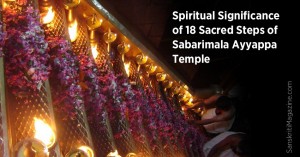
Spiritual Significance of 18 Sacred Steps of Sabarimala Ayyappa Temple
Before one views the Sanctum Sanctorum, one has to climb over eighteen sacred steps. These steps are now covered with `Panchaloham’ ( A Special Composition

Before one views the Sanctum Sanctorum, one has to climb over eighteen sacred steps. These steps are now covered with `Panchaloham’ ( A Special Composition

Shani temple set for January 26 showdown. The temple in Maharashtra’s Ahmednagar district landed in controversy after a woman climbed the platform on November 28 and was
Dictionary defines the word ‘Renunciation’ as follows: ‘the formal rejection of something, typically a belief, claim, or course of action.’ All over the world, we

Azhwars (or Alvar) are the Vaishnavite saints who had composed a collection of 4000 hymns, called Nalayira Divya Prabhandham (4000 divine verses) in praise of
annad bhavanti bhutani parjanyad anna-sambhavah yajnad bhavati parjanyo yajnah karma-samudbhavah (Chapter 3: Karma-yoga TEXT 14) All living bodies thrive on food. Food is produced by

Goddess Saraswati (Saraswatee) is a revered and popular household name among the Hindus of India. She is the personification of knowledge and purity. The well-known


The last Ekadashi before Navratri — and why this one carries extraordinary power for the

One of the most common questions people ask about Hinduism is also one of the

We are delighted to present the 2026 Sanskriti Calendar – a thoughtfully curated blend of timekeeping and

History remembers the empires that towered over the subcontinent. What often gets lost are the

On 11 September 1893, Swami Vivekananda’s “Sisters and Brothers of America” reset the world’s conversation on faith and fellowship. More than a century later, his call for universal brotherhood, respect for diversity, and service over ritual feels newly urgent. In a polarised, hyper-connected age, Vivekananda offers a practical ethic: expand, don’t contract—build character, seek truth, and serve the weakest first.

