
Maun Vrat literally means a vow to keep silent. For spiritual growth it is essential that one’s speech must be pure. To acquire purity of speech the practice of silence is important. Hindu religious texts commend maun-vrat for this purpose.
In Bhadon, sixth month of the Hindu calendar, 16 days of maun-vrat are said to be useful. It is believed that through silence one is able to achieve one’s desire. One attains the abode of Lord Shiva. Along with maun-vrat it is essential that some time must be spent in offering prayers.
In Bhagavad Gita, 17/16, it is said:
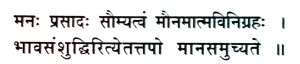
Contentment of the mind, amiable temperament, silence, religious meditation and good thoughts reflect austerity of the mind.
Silence is placed mid-way between other qualities. It begins with control of the mind. once the mind is controlled, one becomes friendly. One begins to look kindly towards others. One cuts down on useless speech and thinks more of God. One begins to generate good thoughts.
In Chanakya Niti, 11/9, it is said:
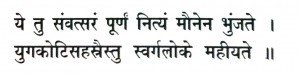
Whoever can remain silent everyday for a full year becomes worthy of thousands of years of praise in heaven.
Silence can change the personality of an individual. Through silence a person controls anger and speech. One grows stronger through greater determination and self-confidence. One is more at peace and free of tension. There is conservation of energy and a person experiences greater inner strength, helping one develop into a better person.
In Mahabharata, there is a story pertaining to silence. After Maharishi Vedavyas had dictated the last shloka and Lord Ganesh had noted it down on the bhojpatra, Maharishi Vedavyas said,
“Viganeshwar! Blessed is your writing! The Supreme Spirit has created the Mahabharata and you have written it. What is more amazing is your silence. During dictation I must have spoken almost twenty hundred thousand words, but all along I did not hear a single word from you.”
Lord Ganesh thoughtfully responded, “Bdryan! Some lamps have a lot of oil; others have only a little. No lamp has a continuous supply of oil. In the same way, gods, mankind and demons have a limited life. Only those who have self-control and use their powers with patience and understanding can fully benefit from their life. The first step to self-control is to control one’s speech. Whoever cannot control his speech loses energy unnecessarily. Through control of speech one avoids such a loss. I have always believed in the power of silence.”
You may ask:
Why is there an emphasis on silence?
We all know that if speech is silvren, silence is golden. Silence helps to conserve energy, to concentrate and introspect. It helps one in the search of divinity. By observing silence one gains goals easily.
~ Prem P. Bhalla