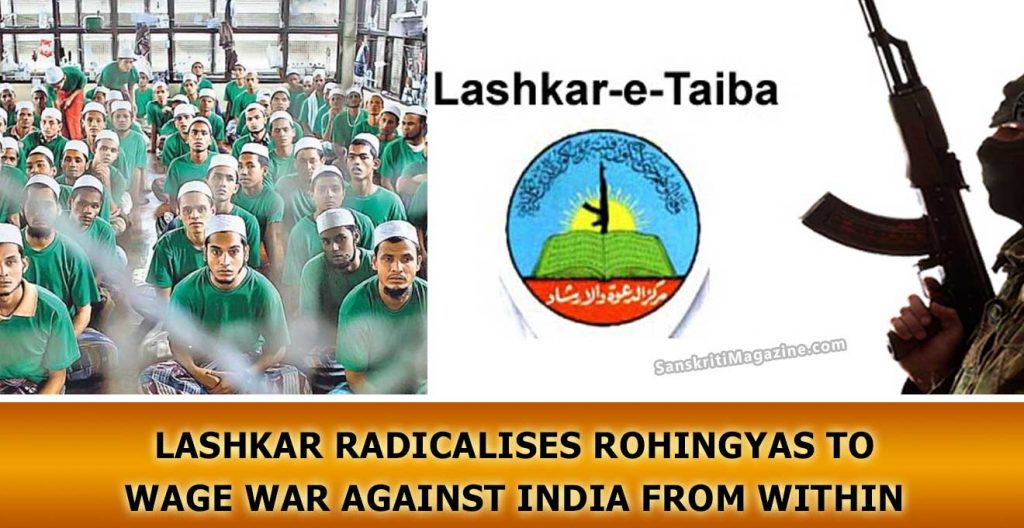
The Bangladesh government has confirmed to New Delhi that terror groups like the Lashkar-e-Toiba (LeT) have instigated Rohingyas to avenge last year’s sectarian violence in Myanmar. Shishir Gupta reports.
The Bangladesh government has confirmed to New Delhi that terror groups like the Lashkar-e-Toiba (LeT) have instigated Rohingyas to avenge last year’s sectarian violence in Myanmar.
This more narrowly focusses on the Indian investigations into the July 7 serial bomb blast at the Mahabodhi temple in Gaya, Bihar, on Islamic militant groups inside India and Bangladesh.
The Rohingyas are Myanmar’s Muslim minority, largely settled in the coastal Arakan province. Myanmar has seen increasing sectarian violence in the past two years between its dominant Buddhist majority and the Rohingyas.
For the first time, senior government sources said, the presence of several thousand Rohingya refugees in India was discussed by senior Home Ministry, police and intelligence officials at the Independence Day security coordination meeting on Tuesday.
An estimated 5,000 Rohingya refugees live around Delhi, with a particularly large number living in slums along Sona Road near Gurgaon. Officials also red flagged such clusters following evidence that a section of the Rohingya community has been radicalized by pan-Islamicist groups.
These groups have attracted a few Rohingyas by promising to help them carry out retribution against Myanmar, Bangladesh and India.
There are sizeable Rohingya populations in Aligarh in Uttar Pradesh, in Andhra Pradesh, Maharashtra and even Jammu and Kashmir. Rohingya refugees are often seen protesting in Delhi outside the United Nations Human Rights Commission asking for UN refugees status.
Indian antennae have been raised since LeT supremo Hafiz Saeed issued a statement on June 1 in Lahore accusing India of assisting the Myanmar regime in its persecution of the Rohingyas.
Intelligence reports from Dhaka have also confirmed the presence of Lashkar commanders on the Bangladesh-Myanmar border. The LeT is believed to be recruiting Rohingyas, offering to help them to seek revenge against the Buddhists through terrorist acts.
According to the Bangladesh government, umbrella organization like Jamaat-ul-Arakan and the Rohingya Solidarity Organization are running terror training camps in remote areas of Bandarban district of Bangladesh adjoining the Myanmar border. With the Bangladesh-Myanmar border turning into a new theatre of global jihad, the US and other Western powers have begun monitoring this area.
After the 2012 Muslim-Buddhist clashes in Myanmar, Bangladeshi security agencies made a series of arrests that revealed plans to radicalize, train and fund some Rohingya refugees with the help of Pakistan based terror groups and Saudi Arabian financiers.
It was through these suspects that Bangladeshi security agencies came to learn of the visit to Arakan of Al Qaeda explosive expert Nur Bashar and the banned Islamic Movement of Uzbekistan’s shura member, Mufti Abu Zarra ul Burmi, who was employed as a teacher in Karachi University before joining IMU in 2004.
LeT attempts to dabble in the Arakan date well before the 2012 violence. They also have an Indian connection. It was Abdul Karim Tunda, a Pilakhuwa (Ghaziabad )-born Lashkar commander who masterminded a series of bombing in North India in 1996-98, who had travelled from Pakistan to Bangladesh over the past decade to explore the possibility of recruiting Rohingya youth for terror.
The Lashkar has been assisted by Rohingya extremist leaders including Rabiul Alam, a Pakistan trained jihadist from the Teknaf region, and another person identified as “Dr Yunus,” who is the coordinator of the Rohingya Solidarity Organisation in Bangladesh.
The terror headache assumes global dimensions as the RSO is being funded by Saudi Arabian NGO World Assembly of Muslim Youth through Dr Yunus and his associate Maulana Rashid of Cox’s Bazaar.
Indian, Bangladesh and Western security agencies are still trying to piece together the Rohingya threat. New Delhi has urged the Yangon military to take up genuine Rohingya grievances, like their economic and social marginalisation in Myanmar, but so far to no avail.
But with the threat assessment of Rohingya refugees on the rise, the Indian home ministry is planning to order a census of refugees in India as a precautionary security move.