IndianSanskriti
Assam-Rifles-gets-its-first-women-contingent

Assam rifles inducts first women batch in regiment with 100 women

A batch of 212 new ‪‎soldiers‬ out of which 100 were women, was added to one of the most decorated regiments of ‪‎Indian Army‬. For the first time‪ Assam Rifles‬ which has a history of 181 years inducted women soldiers into its ranks.

On Wednesday, the Assam Rifles (AR) inducted 100 women among 212 recruits who were put through a year-long training programme and graduated in the passing-out parade at the Assam Rifles Training Centre and School in Nagaland’s Shokhuvi.

The AR, under dual control of the home and defence ministries, broke tradition last March to admit 127 women for training at its school in Dimapur town. They were selected through recruitment rallies conducted across the country. Of the 100, 27 trainees didn’t clear the programme either on medical grounds or failed to clear basic tests.

“Three lady army officers were specially posted to the Dimapur school in March 2014 to plan, raise and institutionalise a separate training company for women recruits,” Lt Col Rahul Josan, AR spokesperson, told HT.

The company was named Lushai Company after a British era hill province that later became a district of undivided Assam and eventually the state of Mizoram.

Lushai Hills is intrinsic to AR’s history; the force’s first battalion, 1 Assam Rifles, was deployed there for more than a century from 1898 to 2003.

“The newly-inducted women soldiers will be posted to various battalions of the force and be used for frisking and interrogation of women when needed, dispersing female mobs, controlling crowd and tackling agitations involving women,” Lt Gen HJS Sachdev, AR director general, said.
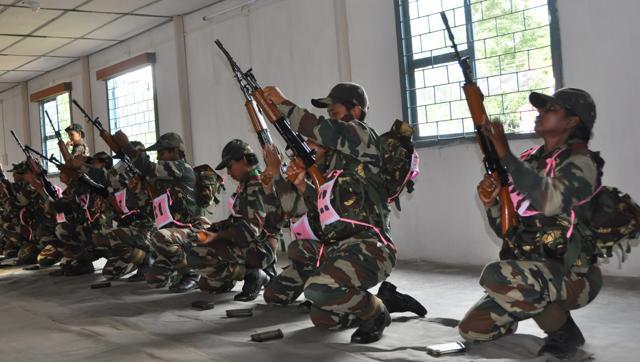
The Assam Rifles inducted 100 women after a year-long training programme at the Assam Rifles Training Centre and School in Nagaland. (HT Photos)

They will also be employed for relief and rescue operations and play a crucial role in avoiding human rights violation and projecting a clean image of the force, he added.

“I am proud that our nation is moving forward in accepting (that) women can do the same job that men can,” Major Zorampari Oinam Joshi, officer in-charge of the first batch of women recruits, said.

Initially constituted to protect British tea planters’ estates from tribal raiders, the AR was called Cachar Levy when it was formed in 1835. It was later called Assam Frontier Police in 1883, which changed to Assam Military Police in 1891, Eastern Bengal and Assam Military Force in 1913 and finally Assam Rifles in 1917.

The AR is the only Indian paramilitary force that has taken part in both the World Wars. Since independence, its 46 battalions have been involved in counter-insurgency operations and vigil along the India-Myanmar border.
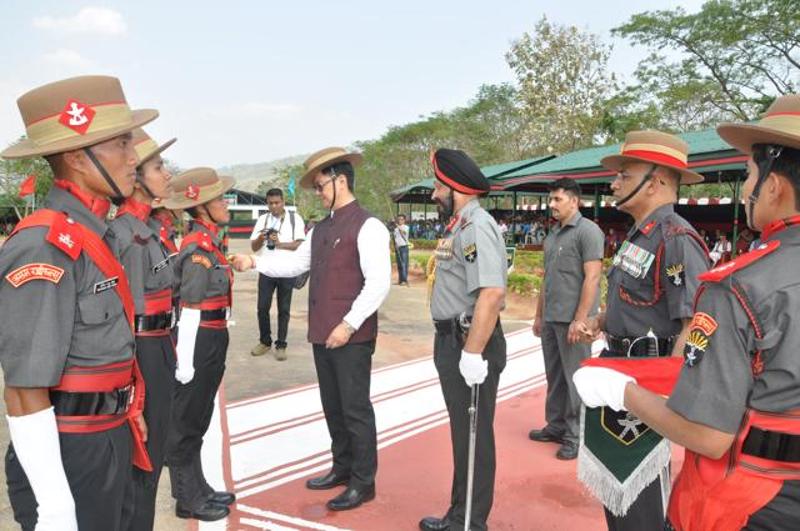

Union minister of state for home, Kiren Rijiju at the passing-out parade of the first batch of women recruits of Assam Rifles in Nagaland. (HT Photos)

You may also like

Search the website

Like us on Facebook

Get daily updates via Email

Enter your email address:

Recent Posts

Yogini Ekadashi 2026 — The Yaksha Who Missed the Morning Flowers, and the Ekadashi That Undid His Curse

On Friday, July 10, 2026, the rare Krishna Paksha Ekadashi of Nija Ashadha arrives. The Padma Purana tells the story of Hemamali — the Yaksha gardener of Bhagavan Kubera in Alaka, whose single morning of distraction with his wife Vishalakshi cost him his form, his wife, and his celestial city. Cursed to wander the earth of Bharata as a leper for a long time, he was at last shown the way back by Sage Markandeya — a single sincere keeping of Yogini Ekadashi.

Jamai Shashthi 2026 — The Story of Maa Shashthi, the Cat, and the Wife Who Was Forgiven

Jamai Shashthi 2026 — The Story of Maa Shashthi, the Cat, and the Wife Who Was Forgiven

On Saturday, June 20, 2026, Bengali households across Bharata will welcome their married daughters and sons-in-law home for the legendary jamai-aador feast and perform the Shashthi Vrata. But behind the warmth lies a story most Bengalis know by heart and most non-Bengalis have never heard — the wife who stole the hilsa, blamed the cat, lost six sons to Maa Shashthi’s wrath, and was finally forgiven. The Vrat Katha, the vidhi, the mantras, and the deeper teaching.

Vat Purnima 2026 — The Wife Who Argued Yama Into Returning Her Husband’s Life

On Monday, June 29, 2026, women across Maharashtra, Gujarat, and southern Bharata will tie red thread around banyan trees and hear the story of Savitri — the wife who walked behind Yamaraja Himself when He came for her husband, and out-argued the Lord of Dharma into returning Satyavan’s life. The Mahabharata’s Pativrata Mahatmya Parva, the vrat vidhi, and why the banyan witnessed everything.

Nija Jyeshtha 2026 — The Real Jyeshtha Begins, and the Calendar Resumes

Nija Jyeshtha 2026 — The Real Jyeshtha Begins, and the Calendar Resumes

With Adhik Maas now closed on the Somvati Amavasya of June 15, the long-postponed festivals of Jyeshtha return — Vat Purnima (June 29, the Savitri-Yamaraja katha), Jamai Shashthi (June 20, the Bengali festival of Maa Shashthi), Sankashti Chaturthi (June 28), Yogini Ekadashi (July 10), and Devshayani Ekadashi (July 16, opening the four-month Chaturmas of Bhagavan Vishnu’s yoga-nidra). A guide to what the next four weeks hold and what the household that kept Purushottam Maas now carries forward.

The Closing of Purushottam Maas 2026 — Adhik Amavasya and the Sealing of the Month-Long Vrat

On Monday, June 15, 2026 — a rare Somvati Amavasya — the intercalary month that bears Bhagavan Vishnu’s own name comes to its close. The Acharyas teach that a vrat is not measured by its duration but by its closing. Here are the Padma Purana’s instructions for sealing the month-long Purushottam Maas vrat: the morning snan, the closing puja with the Vishnu Sahasranama, the day of dana, the Somvati Amavasya gift, and the final sarva-arpana — the offering of all merit at the feet of the Lord.

css.php