IndianSanskriti

Assam Assembly polls: How BJP tackled ST status demand

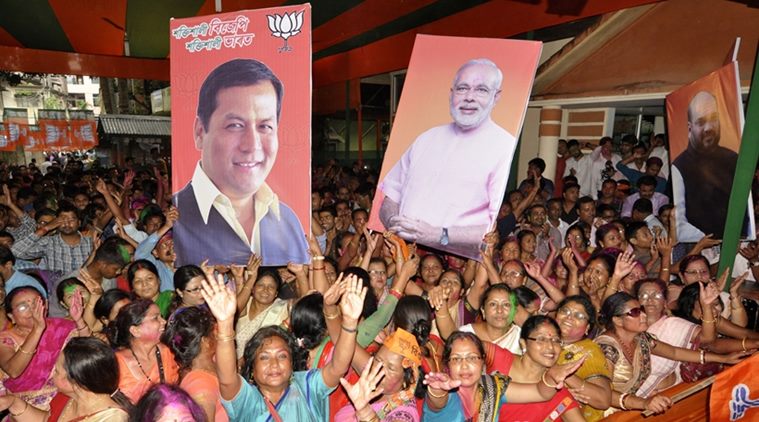
BJP workers celebrate by taking portrait of BJP CM candidate Sarbananda Sonwal and prime minister of India Narendra Modi after their win in Assam State Assembly election 2016 at Hengrabari in Guwahati on Thursday 19th May 2016.Photo-DASARATH DEKA

Elections are as much about satisfying micro-community demands as they are about building macro-level political identities. The BJP’s strategy on the ‘ST question’ indicates its ability to carefully nuance its electoral campaign.

Scheduled Tribes constitute 12.4% of Assam’s population, and for some time, 6 OBC communities — the Tai Ahom, Koch Rajbongshi, Sootea, Moran, Muttock, and the Tea Tribes (or Adivasis) — have been demanding inclusion in the ST category. Their demand is supported by all major parties, and it also found its way to the manifesto of the BJP in 2014. However, the Narendra Modi government’s delay in implementing it had made the communities restive in the run-up to the Assembly election. Apprehensive that the BJP may lose their support, the Modi government at the beginning of March 2016 announced the setting up of a committee to expedite the implementation of their demand.

The survey found that half the voters from these 6 communities were supportive of the ST demand (only 1 in 4 were opposed, most of them being Ahoms, and the rest did not have an opinion) and 48% saw the BJP alliance as being most likely to implement it. This perception also seems to have impacted the way they voted in the election. The survey reveals that the BJP and its partners netted 49% of the vote of these communities; in 2011, this was only one-third.

The Congress, on the other hand, could manage to win only 39% of their vote, 12 percentage points fewer than in the previous Assembly poll. The party’s decline was most precipitous among the Koch Rajbongshis, followed by the Tea Tribes, 70% of whom said that their condition had deteriorated in the last five years.

The BJP’s wooing of these 6 communities came with the risk of alienating the Scheduled Tribe Bodos and Rabhas, who are apprehensive that extending ST status to these communities might affect their benefits. The party overcame this hurdle by, first, forming an electoral alliance with the Bodoland People’s Front and two Rabha and Tiwa organisations and, second, by extending ST status to Bodos in the hills, which the Prime Minister himself announced at a rally. This ensured that any disenchantment among the Bodo and non-Bodo tribes was contained. The BJP-AGP-BPF alliance got 68% of the Bodo vote, a marginal drop from the 71% that it got in 2011. Among the non-Bodo tribes, the party garnered 56% votes as opposed to just about one-third five years ago.

 

You may also like

Search the website

Like us on Facebook

Get daily updates via Email

Enter your email address:

Recent Posts

Yogini Ekadashi 2026 — The Yaksha Who Missed the Morning Flowers, and the Ekadashi That Undid His Curse

On Friday, July 10, 2026, the rare Krishna Paksha Ekadashi of Nija Ashadha arrives. The Padma Purana tells the story of Hemamali — the Yaksha gardener of Bhagavan Kubera in Alaka, whose single morning of distraction with his wife Vishalakshi cost him his form, his wife, and his celestial city. Cursed to wander the earth of Bharata as a leper for a long time, he was at last shown the way back by Sage Markandeya — a single sincere keeping of Yogini Ekadashi.

Jamai Shashthi 2026 — The Story of Maa Shashthi, the Cat, and the Wife Who Was Forgiven

Jamai Shashthi 2026 — The Story of Maa Shashthi, the Cat, and the Wife Who Was Forgiven

On Saturday, June 20, 2026, Bengali households across Bharata will welcome their married daughters and sons-in-law home for the legendary jamai-aador feast and perform the Shashthi Vrata. But behind the warmth lies a story most Bengalis know by heart and most non-Bengalis have never heard — the wife who stole the hilsa, blamed the cat, lost six sons to Maa Shashthi’s wrath, and was finally forgiven. The Vrat Katha, the vidhi, the mantras, and the deeper teaching.

Vat Purnima 2026 — The Wife Who Argued Yama Into Returning Her Husband’s Life

On Monday, June 29, 2026, women across Maharashtra, Gujarat, and southern Bharata will tie red thread around banyan trees and hear the story of Savitri — the wife who walked behind Yamaraja Himself when He came for her husband, and out-argued the Lord of Dharma into returning Satyavan’s life. The Mahabharata’s Pativrata Mahatmya Parva, the vrat vidhi, and why the banyan witnessed everything.

Nija Jyeshtha 2026 — The Real Jyeshtha Begins, and the Calendar Resumes

Nija Jyeshtha 2026 — The Real Jyeshtha Begins, and the Calendar Resumes

With Adhik Maas now closed on the Somvati Amavasya of June 15, the long-postponed festivals of Jyeshtha return — Vat Purnima (June 29, the Savitri-Yamaraja katha), Jamai Shashthi (June 20, the Bengali festival of Maa Shashthi), Sankashti Chaturthi (June 28), Yogini Ekadashi (July 10), and Devshayani Ekadashi (July 16, opening the four-month Chaturmas of Bhagavan Vishnu’s yoga-nidra). A guide to what the next four weeks hold and what the household that kept Purushottam Maas now carries forward.

The Closing of Purushottam Maas 2026 — Adhik Amavasya and the Sealing of the Month-Long Vrat

On Monday, June 15, 2026 — a rare Somvati Amavasya — the intercalary month that bears Bhagavan Vishnu’s own name comes to its close. The Acharyas teach that a vrat is not measured by its duration but by its closing. Here are the Padma Purana’s instructions for sealing the month-long Purushottam Maas vrat: the morning snan, the closing puja with the Vishnu Sahasranama, the day of dana, the Somvati Amavasya gift, and the final sarva-arpana — the offering of all merit at the feet of the Lord.

css.php