IndianSanskriti

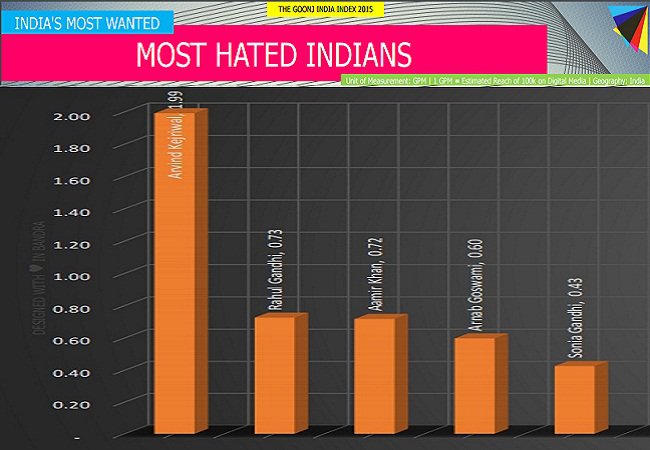
Arvind Kejriwal most hated Indian in 2015 in annual Survey of ‘Goonj India Index 2015’

New Delhi, Jan 6: The annual chronicle ‘Goonj India Index 2015′ has branded Delhi Chief Minister Arvind Kejriwal as most hated Indian in 2015 while Prime Minister Narendra Modi has emerged as the second politician after Dr APJ Abdul Kalam in the most lovable list. The Aam Aadmi Party has also been branded the most hated political party by the same survey.

According to the report published on ‘The Goonj India Index 2015’ portal, the Aam Aadmi Party leader Kejriwal topped the list of most hated Indians in 2015 followed by Congress vice president Rahul Gandhi on the second most hated Indians while Bollywood superstar Aamir Khan was on the third position in that list. The site also mentions Congress president Sonia Gandhi on fifth position in the same list.

The latest report released by Goonj India, a mass media research outlet, tracked down the trends, popular mentions on Twitter, Facebook, Google searches and YouTube viewership to map the popularity of the individuals and whether they were discussed in positive or negative light.

The score has been given in Global Precipitation Measurement (GPM) format where 1 GPM is equal to an estimated reach of 100K on digital media in which Arvind Kejriwal got the highest (1.99 GPM) score in hated list followed by Rahul Gandhi (0.73 GPM) and Aamir Khan (0.72 GPM).


You may also like

Search the website

Like us on Facebook

Get daily updates via Email

Enter your email address:

Recent Posts

Yogini Ekadashi 2026 — The Yaksha Who Missed the Morning Flowers, and the Ekadashi That Undid His Curse

On Friday, July 10, 2026, the rare Krishna Paksha Ekadashi of Nija Ashadha arrives. The Padma Purana tells the story of Hemamali — the Yaksha gardener of Bhagavan Kubera in Alaka, whose single morning of distraction with his wife Vishalakshi cost him his form, his wife, and his celestial city. Cursed to wander the earth of Bharata as a leper for a long time, he was at last shown the way back by Sage Markandeya — a single sincere keeping of Yogini Ekadashi.

Jamai Shashthi 2026 — The Story of Maa Shashthi, the Cat, and the Wife Who Was Forgiven

Jamai Shashthi 2026 — The Story of Maa Shashthi, the Cat, and the Wife Who Was Forgiven

On Saturday, June 20, 2026, Bengali households across Bharata will welcome their married daughters and sons-in-law home for the legendary jamai-aador feast and perform the Shashthi Vrata. But behind the warmth lies a story most Bengalis know by heart and most non-Bengalis have never heard — the wife who stole the hilsa, blamed the cat, lost six sons to Maa Shashthi’s wrath, and was finally forgiven. The Vrat Katha, the vidhi, the mantras, and the deeper teaching.

Vat Purnima 2026 — The Wife Who Argued Yama Into Returning Her Husband’s Life

On Monday, June 29, 2026, women across Maharashtra, Gujarat, and southern Bharata will tie red thread around banyan trees and hear the story of Savitri — the wife who walked behind Yamaraja Himself when He came for her husband, and out-argued the Lord of Dharma into returning Satyavan’s life. The Mahabharata’s Pativrata Mahatmya Parva, the vrat vidhi, and why the banyan witnessed everything.

Nija Jyeshtha 2026 — The Real Jyeshtha Begins, and the Calendar Resumes

Nija Jyeshtha 2026 — The Real Jyeshtha Begins, and the Calendar Resumes

With Adhik Maas now closed on the Somvati Amavasya of June 15, the long-postponed festivals of Jyeshtha return — Vat Purnima (June 29, the Savitri-Yamaraja katha), Jamai Shashthi (June 20, the Bengali festival of Maa Shashthi), Sankashti Chaturthi (June 28), Yogini Ekadashi (July 10), and Devshayani Ekadashi (July 16, opening the four-month Chaturmas of Bhagavan Vishnu’s yoga-nidra). A guide to what the next four weeks hold and what the household that kept Purushottam Maas now carries forward.

The Closing of Purushottam Maas 2026 — Adhik Amavasya and the Sealing of the Month-Long Vrat

On Monday, June 15, 2026 — a rare Somvati Amavasya — the intercalary month that bears Bhagavan Vishnu’s own name comes to its close. The Acharyas teach that a vrat is not measured by its duration but by its closing. Here are the Padma Purana’s instructions for sealing the month-long Purushottam Maas vrat: the morning snan, the closing puja with the Vishnu Sahasranama, the day of dana, the Somvati Amavasya gift, and the final sarva-arpana — the offering of all merit at the feet of the Lord.

css.php