Ahimsa Paramo Dharma
अहिंसा परमो धर्मः
A Sanskrit phrase largely popularized by Gandhi and is repeated by many across the world today to emphasise on Non-Violence.
The phrase was first used in Mahabharata and literally means “non-violence is the ultimate duty” to the extent that it supersedes all other duties.
For someone following this practice, it means that there is no selective application of practice of ahimsa. It must be applied to each and everything related to their lives, leading to an unconditional and unilateral abandonment of violent resistance under any and all circumstances. Yet, this is true only in the philosophy and strict practitioners of Buddhism and Jainism.
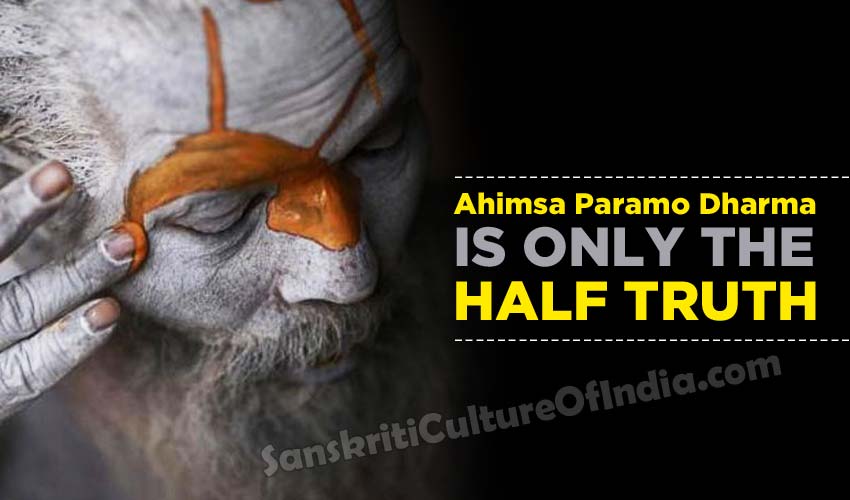
Many of us are so familiar with this phrase that we do not realize that it is only the half-truth. The full phrase in Mahabharata is:
अहिंसा परमो धर्मः
धर्म हिंसा तथैव च
Non-violence is the ultimate dharma.
So too is violence in service of Dharma.
In Sanatana Dharma, the first line of the phrase is only applicable to the renunciates and the ascetics. Even if provoked, a Sannyansin should not defend himself even when his life is in danger because he identifies himself with the Atman rather than associating with his body.
However it is the second line that is purposefully dropped by the preachers of Dharma and Ahimsa.
The word, non-violence in English is absolute in its meaning but ahimsa means non-violence in a relative sense. In Sanatana Dharma, it is the moral duty of a person to practice violence if it is used to stop a greater violence or evil. For example, in order to keep peace and order in his country, a king has to be strict in his punishment. To practice ahimsa, he may even have to kill a man who is, for example, taking away the lives of others.
So, the statement, when taken in full context and meaning within Sanatana Dharma, is applicable to most people.
In ancient times, it was the duty of a Brahmin to be well versed in matters of spirituality and be benevolent and kind to all creatures, while a Kshatriya was the protector of everything including Dharma.
In Adi Parva, it is stated:
अहिंसा परमॊ धर्मः सर्वप्राणभृतां समृतः
तस्मात पराणभृतः सर्वान न हिंस्याथ बराह्मणः कव चित
Verily the highest virtue of man is sparing the life of others. Therefore a Brahmana should never take the life of any creature.
बराह्मणः सौम्य एवेह जायतेति परा शरुतिः
वेथवेथाङ्गवित तात सर्वभूताभय परथः
A Brahmana should be versed in the Vedas and Vedangas, and should inspire all creatures with belief in God.
अहिंसा सत्यवचनं कषमा चेति विनिश्चितम
बराह्मणस्य परॊ धर्मॊ वेथानां धरणाथ अपि
He should be benevolent to all creatures, truthful, and forgiving, even as it is his paramount duty to retain the Vedas in his memory.
The duties of the Kshatriya are not thine. To be stern, to wield the sceptre and to rule the subjects properly are the duties of the Kshatriya.
In short, he states that a Brahmin should never take the life of any creature, however a Kshatriya may do so as it may be required to ensure proper rule of law and order.
In Vana Parva, Markandya Muni narrates:
काललॊभ गरहाकीर्णां पञ्चेन्थ्रिय जलां नथीम
नावं धृतिमयीं कृत्वा जन्म थुर्गाणि संतर
करमेण संचितॊ धर्मॊ बुथ्धियॊगमयॊ महान
शिष्टाचारे भवेत साधू रागः शुक्लेव वाससि
Virtuous men are always kind to all creatures, and well-disposed towards regenerate men. They abstain from doing injury to any creature, and are never rude in speech. Those good men, who know well the consequences of the fruition of their good and evil deeds, are commended by virtuous men.
The above statement uses “ahimsa” to emphasize on non-injury to any creature by spiritual or holy men.
This phrase is not found in Bhagavad Gita as it is often depicted. On the other hand, Lord Krishna tells Arjuna to get up and fight:
अथ चेत्त्वमिमं धर्म्यं संग्रामं न करिष्यसि
ततः स्वधर्मं कीर्तिं च हित्वा पापमवाप्स्यसि
If, however, you do not fight this religious war, then you will certainly incur sins for neglecting your duties and thus lose your reputation as a fighter.
In this instance, it is the duty of a man to fight against injustice and evil rather than practice the greater dharma of non-violence. Lord Krishna clearly states that ahimsa, while highly regarded, is not the highest dharma for everyone and certainly not for Arjuna on the battlefield of Kurukshetra.
When a person turns away from sensory objects by giving up the doership of action and embraces the Inner Self (the Atman) in pursuit of Jnana and Moksha, then they rightfully follow the path of Ahimsa.
But for a householder still involved in worldly pursuits, the path of ahimsa is impractical. For example, practicing ahimsa when someone enters a house and molests a householder’s wife or child would be an act of cowardice. In the same manner, a soldier cannot put down his weapons in a war; nor can a king let criminals and neighbouring kingdoms continue oppressing and attacking his subjects and pretend to be a follower of non-violence.
In either of the cases above, practicing of ahimsa would be adharma, not Dharma!
Even Lord Krishna states:
परित्राणाय साधूनां विनाशाय च दुष्कृताम्
धर्मसंस्थापनार्थाय सम्भवामि युगे युगे
To deliver the pious and to annihilate the miscreants, as well as to reestablish the principles of religion,
I Myself appear, millennium after millennium.