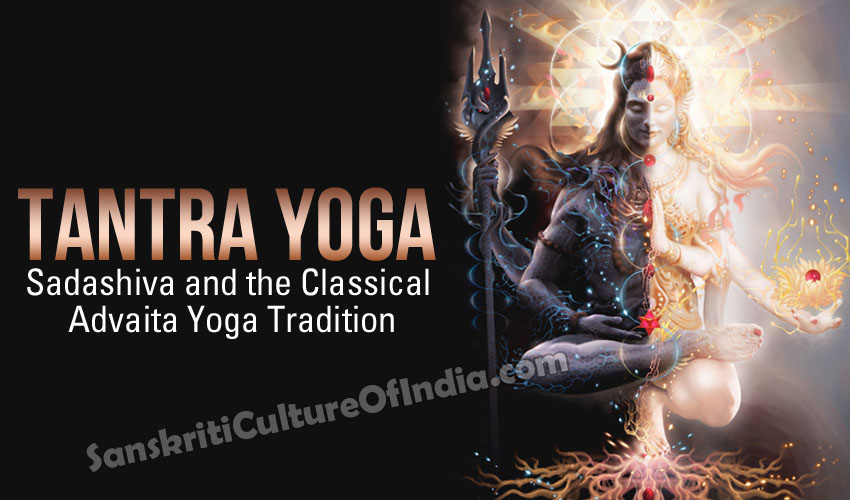
Classical Advaita Tantra Yoga tradition was fathered by Lord Sadashiva, the original expounder of Tantra, the indigenous mystical tradition of Eastern India. He is supposed to have lived around 5000 BC in Eastern India, a contention supported by archaeological explorations in the area.
About Sadashiva – Father of Tantra Yoga
Sadashiva is traditionally considered the founder of Tantra and Yoga systems and the first one to introduce music, dance, medical and marriage systems to human civilization. He was a remarkable human being in whom the Supreme Being was fully manifest; as such, he was the bridge between the phenomenal and spiritual worlds, and thus fully capable of systematizing, developing and inventing tools for spiritual growth. He was so revered for his spiritual and social service accomplishments that he was elevated to a status of Divinity in India: Lord Sadashiva, the destroyer of spiritual ignorance and the Lord of Yogins.
The Teachings of Sadashiva
Over the past millennia, the original teachings of Lord Sadashiva were preserved in the classical Advaita Shaiva Tantra Yoga tradition. If we define science as the rigorous inquiry into the nature of reality, Tantra would be the science of spiritual journey. The term “tantra” means liberation through expansion; thus the discipline rigorously explores all energies and their application associated with human existence and human environment. This exploration markedly does not limit itself to the intellect but uses all faculties available to humans. This acquisition of knowledge is never purely for the sake of knowledge but for the express purpose of enriching human life and for practical use in the exploration of its spiritual dimension.
Classical Tantra Yoga tradition
Classical Tantra Yoga tradition asserts that this universe we live in, and are part of, is the manifestation of Brahma – the infinite, all-embracing, ever-blissful Supreme Conscious Being. It has been observed to manifest in two polar but interrelated ways: Shiva, the Eternal Consciousness, and Shakti, his creative power. Both of these principles cannot be distinct entities; they are two poles of the One Being experiencing itself.
Shiva and Shakti
According to the wish of Shiva and under the influence of Shakti, living beings identify with material and mental objects created by Shakti, and thus feel incomplete due to the lack of connection with Shiva. After they attain human life, they can perform a spiritual practice to accelerate the development of consciousness, i.e. identification with Shiva, the Eternal Consciousness.
This spiritual practice (meditation) will reveal that all manifested objects are a play of Shiva and Shakti and that both are simply two faces of one Brahma, the Supreme Conscious Being. This realization restores living beings to their original state of Eternal Bliss, which is the state of the Supreme Being or Brahma.
Attaining Brahma – Eternal Bliss
In fact, it is said in Sanskrit: “Brahma is Eternal Bliss.” Brahma can be experienced through direct perception deep within one’s own mind. Well-performed spiritual practices help explore and master the mind and eventually lead to the realization of our inherent eternally blissful existence, i.e. unity with Brahma, the Eternal Bliss.
All teachings of the Tantra Yoga tradition are preparations and directions leading one towards the unfolding of this realization. Classical Tantra Yoga tradition uses two main approaches to the realization of Brahma: The first one is simply a gradual effort to release oneself from habitual or addictive behaviors. It is a preparation for the other, subtler system of practices, called yoga. Classical yoga training teaches sophisticated methods of releasing oneself from habitual behavior and deepening one’s feeling of connectedness to the Eternal Bliss. The final spiritual consummation is the direct experience of the Eternal Bliss that leads to dissolution of individuality, which is the source of all happiness.
~ Shri Aghorinath Ji