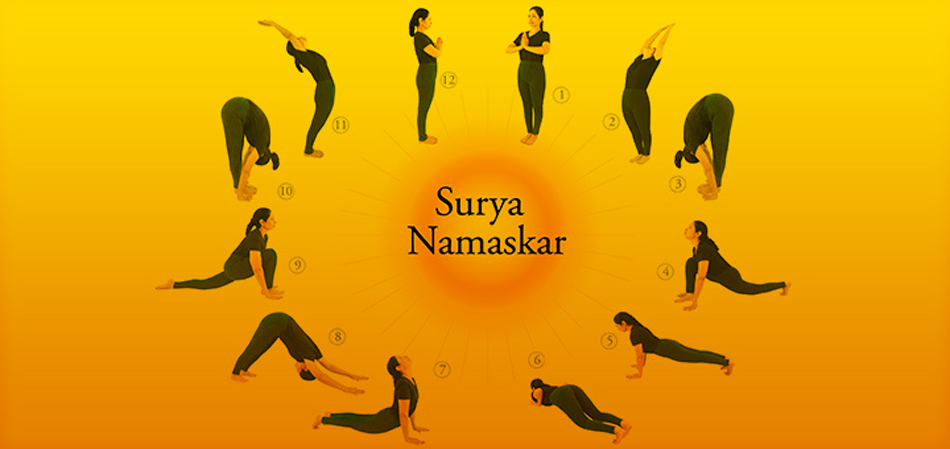
In Hinduism, the Sun god is worshiped as a symbol of health and immortal life. The Rig Veda declares that “Surya is the Soul, both of the moving and unmoving beings”. The Sun Salutation originated as a series of prostrations to the sun. Traditionally, it is performed at dawn, facing the rising sun. In time, each of the twelve positions came to have its own mantra, celebrating aspects of the sun’s divinity.
The Sun Salutation is a graceful sequence of twelve positions performed as one continuous exercise. Each position counteracts the one before, stretching the body in a different way and alternately expanding and contracting the chest to regulate the breathing. Practiced daily it will bring great flexibility to your spine and joints and trim your waist.
The straightforward Surya Namaskar that has been practiced in India for years has not too long ago discovered lots of takers.And if you wish to have a just right begin to your day, what higher than the Surya Namaskar, which is legendary to have a number of health benefits. There are 12 completely different poses to do in a Surya Namaskar and also you’re recognized to have completed a whole spherical while you’ve carried out two consecutive sets.
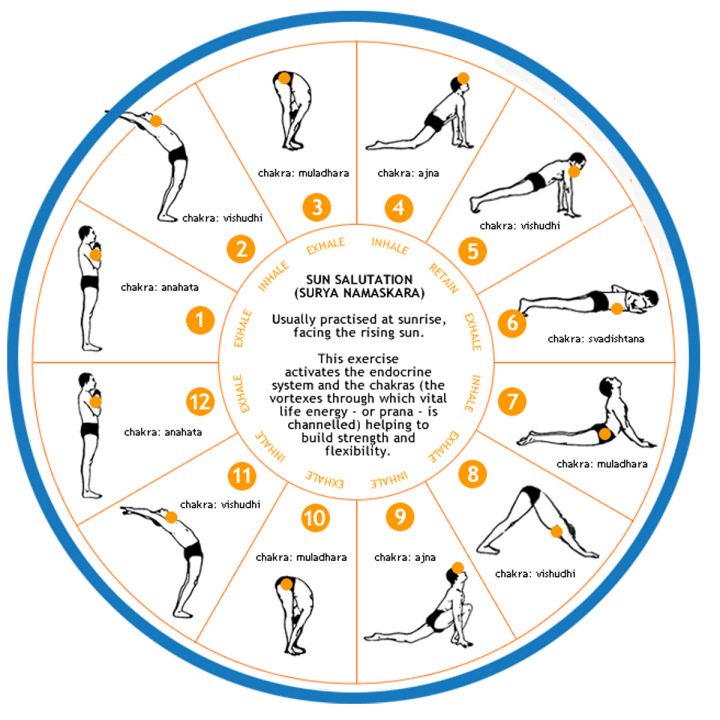
Surya Namaskar stimulates nearly each system on your body – the cardiovascular system as a result of it retains the heart strong and, the digestive system as well as the nervous system.
– It additionally makes Endocrinol glands like thyroid, parathyroid and pituitary glands, function normally.
– Practicing Surya Namaskar regularly can also be recognized to ease stress and give you peace of mind in addition to growing your levels of concentration.
– If you have trouble sleeping at night time, the Surya Namaskar will help you go to sleep with out the usage of any external stimulants.
One round of Sun Salutation consists of two sequences, the first leading with the right foot in positions 4 and 9, the second leading with the left. Keep your hands in one place from positions 3 to 10 and try to co-ordinate your movements with your breathing. Start by practicing four rounds and gradually build up to twelve rounds.
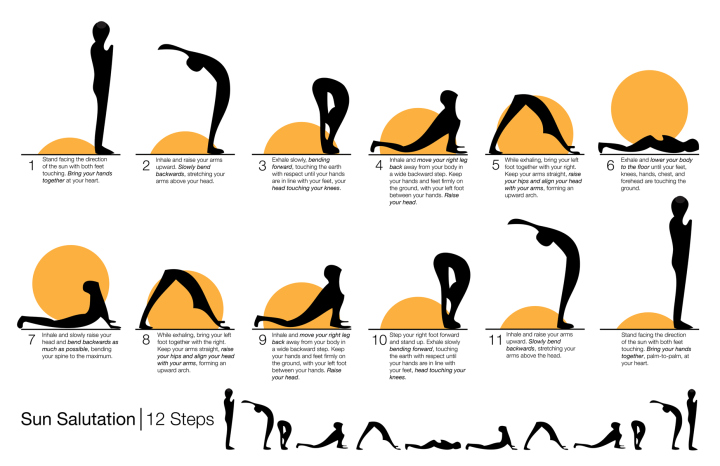
- Stand erect with feet together and hands in the prayer position in front of your chest. Make sure your weight is evenly distributed. Exhale.
- Inhaling, stretch your arms up and arch back from the waist, pushing the hips out, legs straight. Relax your neck.
- Exhaling, fold forward, and press your palms down, fingertips in line with toes – bend your knees if necessary.
- Inhaling, bring the left (or right) leg back and place the knee on the floor. Arch back and look up, lifting your chin.
- Retaining the breath, bring the other leg back and support your weight on hands and toes.
- Exhaling, lower your knees, then your chest and then your forehead, keeping your hips up and your toes curled under.
- Inhaling, lower your hips, point your toes and bend back. Keep legs together and shoulders down. Look up and back.
- Exhaling, curl your toes under, raise your hips and pivot into an inverted “V”shape. Try to push your heels and head down and keep your shoulders back.
- Inhaling, step forward and place the left (or right) foot between your hands. Rest the other knee on the floor and look up, as in position 4.
- Exhaling, bring the other leg forward and bend down from the waist, keeping your palms as in position 3.
- Inhaling, streach your arms forward, then up and back over your head and bend back slowly from the waist, as in position 1.
- Exhaling, gently come back to an upright position and bring your arms down by your sides.