They say that childhood is the best time of our lives. A time of love and laughter, of being pampered, of learning and discovering where our own particular strengths lie.
Children have the right to a joyful childhood. Every child has the right to grow up in a safe and nurturing environment with protection and guidance from their guardians. Whether in the cities or in villages, at home or in schools, a child is always a child and deserves a childhood free from exploitation and abuse.
Yet millions of children are being robbed of their childhoods every day.
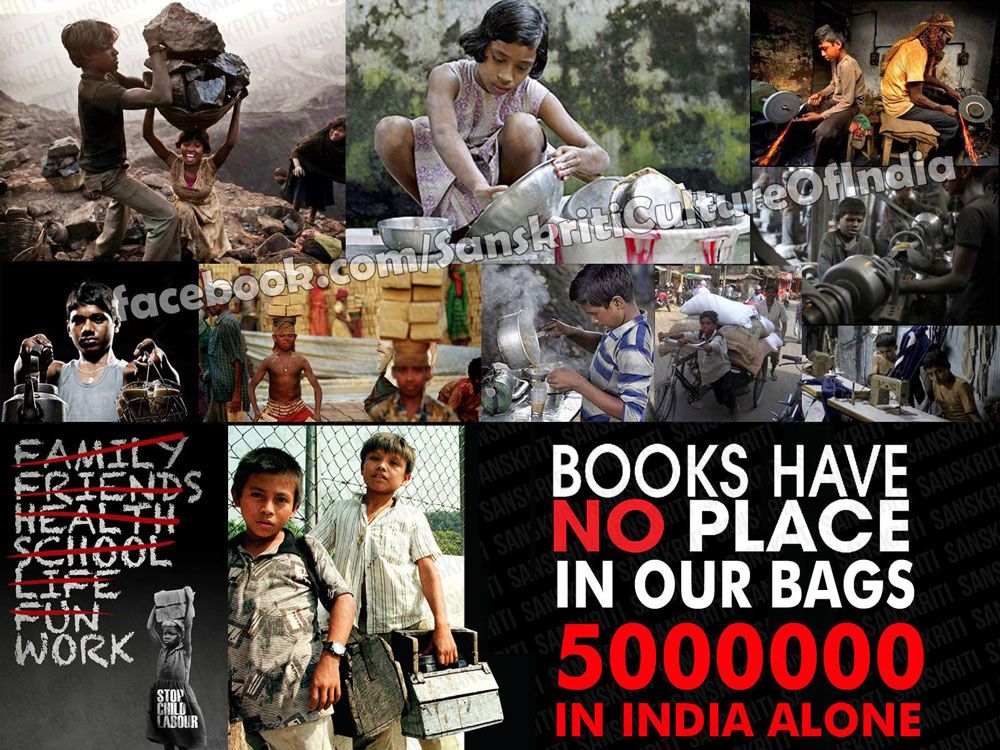
Unfortunately, for a whole lot of Indian children, the harsh reality of childhood is quite different. These children help support their families, doing agricultural labour or working in homes or hazardous industries. Fifty lakh / 5 million children eke out a livelihood in the country, of whom 17.5 lakh are in Uttarakhand, according to the National Sample Survey Organisation (NSSO).
They are employed in many industries and trades, including garments, footwear, brick kilns, stainless steel, hotels, and textile shops. Many work in export-oriented hazardous industries like carpet weaving, gem polishing, glass blowing, match works, brassware, electro-plating, lead mining, stone quarrying, lock making and beedi rolling (indigenous cigarette in which tobacco is rolled in a tendu leaf).
In addition, nearly 85 per cent of child labourers in India are hard-to-reach, invisible and excluded, as they work largely in the unorganised sector, both rural and urban, within the family or in household-based units, which are generally out of the purview of labour laws.
Poverty and lack of social security are the main causes of child labour. The increasing gap between the rich and the poor, privatization of basic services and the neo-liberal economic policies are causes major sections of the population out of employment and without basic needs. This adversely affects children more than any other group. Entry of multi-national corporations into industry without proper mechanisms to hold them accountable has lead to the use of child labour. Lack of quality universal education has also contributed to children dropping out of school and entering the labour force. A major concern is that the actual number of child labourers goes un-detected. Laws that are meant to protect children from hazardous labour are ineffective and not implemented correctly.
A growing phenomenon is using children as domestic workers in urban areas. The conditions in which children work is completely unregulated and they are often made to work without food, and very low wages, resembling situations of slavery. There are cases of physical, sexual and emotional abuse of child domestic workers. The argument for domestic work is often that families have placed their children in these homes for care and employment. There has been a recent notification by the Ministry of Labour making child domestic work as well as employment of children in dhabas, tea stalls and restaurants “hazardous” occupations.
What can you do to help?
————————–
Despite the enormity of the problem, child labour is a phenomenon that can be combated, not only by policy makers, but also by ordinary citizens. Below are some suggestions on what people can do to take action and get involved in the fight against child labour:
• Instead of employing a child as a domestic help, try employing their parents instead.
• Discourage others from employing children.
• Ensure that they send their children to school.
• Initiate or join a campaign that works on issues of abuse, exploitation, any situation that denies a child right’s to protection.
• Don’t buy products from manufacturers who employ child labour.
No individual, no organization, even the largest one, can begin to stop child labour on its own, and no action, even the smallest, can be dismissed as being too small to bring about change. It is only through joining the forces of goodwill on all levels of society that we can hope to put an end to child labour.