Friday, July 10, 2026 · Nija Ashadha, Krishna Paksha Ekadashi · Yogini Ekadashi Vrat · Religion · Festivals
The Padma Purana’s story of Hemamali, gardener of Kubera — how a single morning’s distraction cost him his form, his wife, and his kingdom, and how a single Ekadashi returned all three.
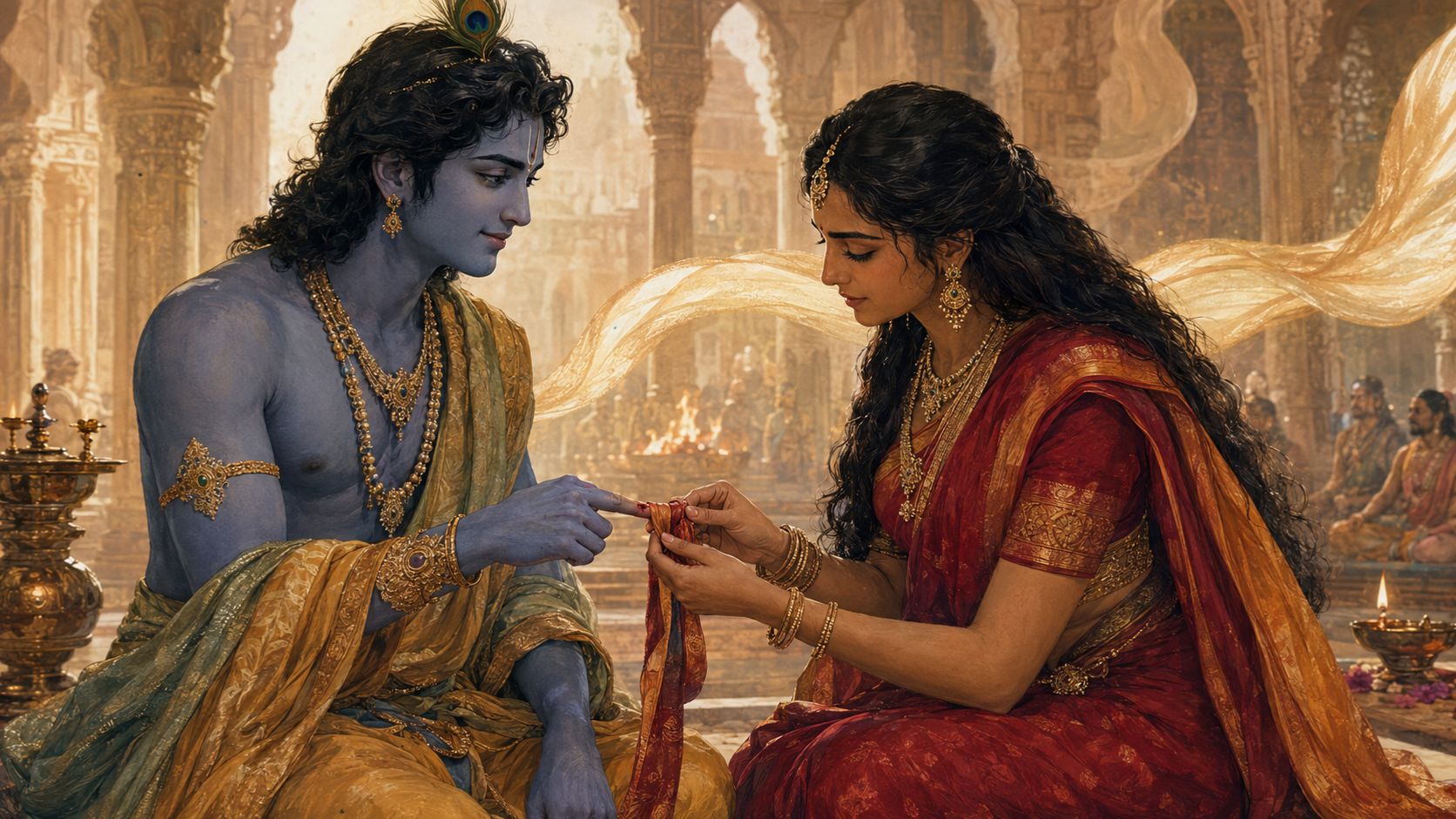
There is a small silence the Bhagavata carries when it speaks of Yogini Ekadashi. Of the twenty-four Ekadashis of the ordinary year, this one is not among the most celebrated, and not among the most publicly kept. But of all of them, the Acharyas of the Vaishnava tradition teach, this is the one they most quietly reserve for their own sadhakas — the ones whose sadhana has been interrupted, whose discipline has quietly slipped, whose morning has, for a season, stopped being the morning it used to be.
This year, Yogini Ekadashi falls on Friday, July 10, 2026. It is the Krishna Paksha Ekadashi of Nija Ashadha — the eleventh day of the dark fortnight of the “real” Ashadha, the month that opens after the calendar has resumed from Adhik Maas. The Padma Purana, in the words of Bhagavan Krishna to Yudhishthira, names the merit of a single sincere keeping of this Ekadashi as equal to feeding eighty-eight thousand Brahmanas.
The Purana explains why through a story. It is the story of a Yaksha named Hemamali — the gardener of Bhagavan Kubera — and of a single morning that broke his life in two.
Alaka, and the Gardener Who Never Missed a Morning
North of the Himalayas, in the reaches that even the winds of Bharata do not touch, lies Alaka — the celestial city of Bhagavan Kubera, the Lord of Yakshas and the keeper of the treasures of the earth. Its walls are gold. Its gates open onto Lake Manasarovar. And its inner gardens grow the rarest flowers of any world — flowers whose petals do not fall, whose fragrance does not fade, whose colours are not repeated anywhere in the three realms.
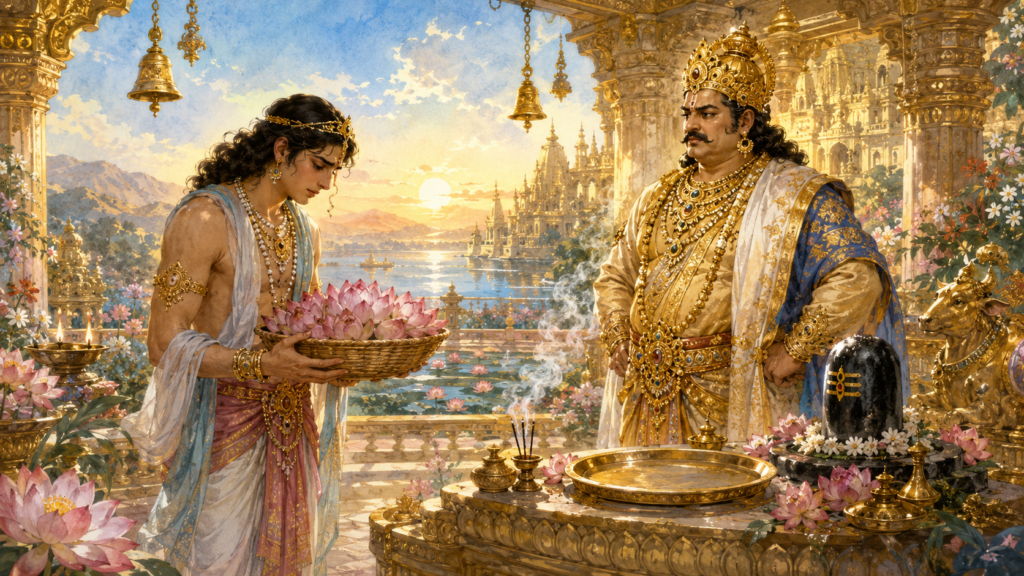
In one of those gardens lived a Yaksha named Hemamali. He was Kubera’s flower-gatherer. His single task, appointed to him by Kubera himself, was small in outward form and enormous in inward weight: every morning before dawn, he was to walk to Manasarovar, gather a basket of its lotuses, return to Alaka before the sun crossed the meridian, and lay them at the feet of Bhagavan Shiva — for Kubera himself was a devotee of the Lord of Kailash, and no morning puja in Alaka’s temple was complete without the flowers Hemamali brought.
For years Hemamali kept the appointment. Whatever the weather. Whatever the season. His feet knew the path. The lotuses knew his hands.
He had, however, one weakness. His wife — Vishalakshi — was among the most beautiful of the Yakshis, and he loved her with a completeness that the Yaksha tradition does not often name. The mornings, when he rose to gather the flowers, were the only hours he was apart from her.
The Morning He Did Not Rise
One morning, the Padma Purana records with a great gentleness, Hemamali did not rise.
He had returned late the previous night, after the puja was already done. Vishalakshi had waited for him. The air of Alaka was full with the scent of jasmine. He lay down beside her.
When he woke, the sun was already high.
The lotuses had not been gathered. The morning puja had come and gone without them.
Hemamali dressed in haste. He filled the basket at Manasarovar. He returned to Alaka. He entered the temple.
Bhagavan Kubera was already there, seated before the altar, the puja finished, the flower-tray empty. He did not turn to look at Hemamali.
“Where were you this morning?” he asked.
Hemamali stood silent.
The Lord of Alaka rose. His voice, when it came, was not raised. But the Puranas record that every Yaksha in Alaka heard it.
“You have kept your wife before the Lord you were appointed to serve. You have chosen the pleasure of one night over the offering of one morning. There is a karma in this that Alaka cannot hold. Go — leave the city. Fall to the earth of Bharata. Take with you the form your act deserved. You shall be a leper. Your wife shall be taken from you. You shall wander through the world separated from her, from Alaka, from every ordinary comfort — until you have found the way back.”
The words were spoken. The Puranas say that Hemamali did not have time to answer. Alaka’s floor dissolved beneath him. The sky opened. He fell.
When he landed on the earth of Bharata, his skin had already begun to split. Vishalakshi was gone. Alaka was closed to him. He rose to his feet on a plain he had never seen before and began, without direction, to walk.
The Sage in the Forest
The Purana does not say how long Hemamali wandered. It says only that he wandered for a long time. He passed through villages that turned him away at the well. He slept in fields under the cold winds. He begged for food. He remembered Vishalakshi.
At last, at the end of a long forest path, he came to the ashrama of the great rishi Markandeya.
Markandeya received him. He gave him water. He gave him a seat. And when he had listened to Hemamali’s story — the morning, the flowers, the wife, the curse — the rishi was silent for a long while.
Then he spoke.
“Yaksha, the karma that fell on you is not a small karma. To place any pleasure before the Lord one has been appointed to serve is one of the graver aparadhas the Shastras name. But no karma is greater than the grace of Bhagavan Vishnu, and no aparadha is beyond what one keeping of the right Ekadashi can undo.”
He named it.
“In the Krishna Paksha of Ashadha falls Yogini Ekadashi — the Ekadashi named for the eight Yoginis of Devi, the eight forms of Maha-Shakti that cleanse the karma the ordinary Ekadashis cannot reach. It is the Ekadashi for the sadhaka whose sadhana was interrupted by an entanglement he could not himself end. It is the Ekadashi for the seeker who has fallen and cannot rise. Keep it, Yaksha, with the completeness a rare Ekadashi requires. Bhagavan Vishnu will hear.”
Markandeya taught him the vidhi. Hemamali kept the vrat.
The Padma Purana records what happened. On the morning of the parana, Hemamali woke to find the skin of his body restored. The wounds of the wandering were gone. He rose from the earth of Bharata whole. Above him the sky opened once again. Alaka appeared. Vishalakshi was on its threshold. Kubera stood behind her, and the Lord of Alaka’s face — this time — was gentle.
“Return, Yaksha. Take back your appointment. Take back your wife. Take back your morning. What was done has been undone. Do not forget the fast that undid it.”
Hemamali returned. He kept the puja. He kept the fast every Ashadha thereafter. The Puranas say that he was, in time, among the most steadfast of Kubera’s Yakshas — and that his story is the story that the Padma Purana quietly hands to every sadhaka whose sadhana has, in some season, slipped from what it once was.
Yogini Ekadashi 2026 — Timings
| Ekadashi Tithi Begins | 08:16 AM, Friday, July 10, 2026 |
|---|---|
| Ekadashi Tithi Ends | 05:22 AM, Saturday, July 11, 2026 |
| Vrat Day | Friday, July 10, 2026 |
| Parana | Saturday, July 11, 2026 — 01:59 PM to 04:37 PM IST |
Vrat Vidhi
- Rise at Brahma Muhurta. Bathe in cool water with a few drops of Ganga jal added. Wear clean clothes — yellow or white is preferred.
- Take the sankalpa before Bhagavan Vishnu. For Yogini, the Padma Purana enjoins that the sankalpa name the specific interruption the sadhaka wishes cleansed — the sadhana that has slipped, the discipline that has broken, the aparadha whose weight is still being carried.
- Establish the puja with tulsi, yellow flowers, sandal paste, ghee deepa, fruits, and panchamrita. Chant the dvadasha-akshara mantra on a tulsi mala. The Padma Purana also enjoins the recitation of the Ashta-Yogini Stotra — a stotra to the eight Yoginis — for the specific cleansing this Ekadashi carries.
- Keep the fast — phalahari for householders, nirjala for those who can.
- Through the night, keep jagrana with recitation of the Vishnu Sahasranama and the reading of the Yogini Ekadashi katha from the Padma Purana.
- Break the parana on Saturday afternoon within the prescribed window — the Padma Purana is exact about the Yogini parana falling in the aparahna (afternoon), not the morning as with most Ekadashis, so that the merit of the vrat is sealed by the completion of the full tithi.
Mantras
Om Namo Bhagavate Vasudevaya — the dvadasha-akshara mantra
Om Yoginyai Namah — for the cleansing named in the sankalpa
Om Namo Narayanaya — the closing mantra
The Deeper Teaching
The Acharyas point to a small line in the Padma Purana about Hemamali that is easy to miss.
When Kubera cursed him, the Purana does not say that Hemamali had done a great evil. He had not stolen. He had not lied. He had not injured any Jivatma. He had simply, on one morning, been late.
The Purana is making a point.
The gravity of an aparadha is not measured by the harm it does to the world. It is measured by the appointment it broke with the Lord. Hemamali’s task was small. The morning flowers before Bhagavan Shiva. But it was his appointment — his one act of daily seva — and to place anything before it was to break the covenant that held his life in Alaka in place.
This is what the Yogini Ekadashi cleanses. It is not the great sins. It is the small daily broken appointments — the mornings the sadhaka did not rise, the japas that slipped from the count, the promises to the Lord that were quietly set aside. The karma of these accumulates without the sadhaka noticing. It does not fall on the world. It falls on the sadhana itself. It slows the inner room. It withdraws the light one morning at a time.
Yogini restores the appointment. The Ekadashi is not for the great fallen. It is for the small slipped.
And in the calendar of the year, on the Krishna Paksha of Ashadha, in the quietest fortnight of the summer, the Lord opens a door He does not open elsewhere: the door back to the morning you meant to keep and did not.
May whoever needs it walk through it this Friday.
Om Namo Bhagavate Vasudevaya