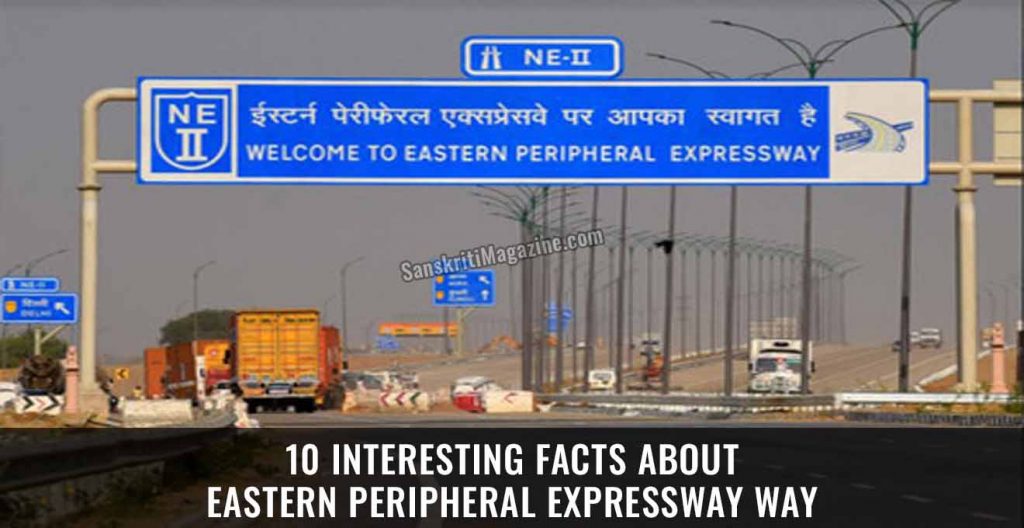
The 135-km Eastern Peripheral Expressway, built at a cost of Rs 11,000 crore, has several unique features and is India’s first highway to be lit by solar power besides provisions of rainwater harvesting on every 500 metres on both sides and would showcase 36 national monuments and 40 fountains.
Here are 10 things you need to know about Eastern Peripheral Expressway
1.The expressway is powered by solar panels. There are 8 solar power plants on this expressway having a capacity of 4000-kilowatt (4 MW).
2.The state-of-the-art road will also have auto challans for over-speeding, as cameras will capture speed of vehicles, besides it will have provisions of tolling only for the distance travelled. The expressway has an iconic toll plaza at the entry point on Kundli side besides digital art gallery. It is equipped with smart and intelligent highway traffic management system (HTMS) and video incident detection system (VIDS) and will set a benchmark in highway construction by being environment-friendly with world-class safety features and smart/interactive infrastructure.
3.The foundation stone of the greenfield project was laid by Prime Minister Narendra Modi on November 5, 2015. The highway has been completed in a record 500 days.
4.According to the ministry, 2.5 lakh trees have been planted along the highway including transplant of 8-10 year old trees and drip irrigation provision has been done.
5.It has consumed 11 lakh tonnes of cement, 1 lakh tonnes of steel, 3.6 crore cum earthwork and 1.2 cr cum fly-ash, the minister said adding the project has generated employment opportunities of about 50 lakh man-days and 9,375 manpower was deployed here.
6.A lot of traffic, outbound or non-destined for Delhi will be diverted, adding at least 50,000 vehicles going to Jammu and Kashmir, Punjab, Haryana, Uttarakhand, Uttar Pradesh and Rajasthan will be diverted, bringing down vehicular pollution.
7.The alignment of EPE starts near Kundli and passes through six parliamentary constituencies, viz Sonepat, Baghpat, Ghaziabad, Noida, Faridabad and Palwal. The fully access controlled six-lane expressway provides entry and exit designated interchanges only and has 406 structures of which 4 are major bridges, 46 minor bridges, 3 flyovers, 7 inter-changes, 221 underpasses and 8 road over bridges (ROBs).
8.The amenities include retail fuel outlets, rest rooms, motels, restaurants, shops etc. Some of the monuments’ replicas pertain to Ashoka Lion, Ashoka Chakra, Konark Temple, Jalianwala Bagh, Gateway of India, Qutab Minar, Char Minar, Lal Quila, Kirti Stambh, India Gate, Hawa Mahal and Gujarat Carving.
9.The project had earlier faced resistance from farmers over land and other issues which have since been solved by giving higher compensation.
10.The Supreme Court on May 10 had directed the NHAI to throw open the Eastern Peripheral Expressway for the public by May 31, asking why were they “waiting” for its inauguration by the Prime Minister. The apex court had said if the 135-km expressway, which envisages signal-free connectivity between Ghaziabad, Faridabad, Gautam Budh Nagar (Greater Noida) and Palwal, is not inaugurated on or before May 31, it should be thrown open for public who were facing traffic congestion in Delhi.
Source : PTI