IndianSanskriti
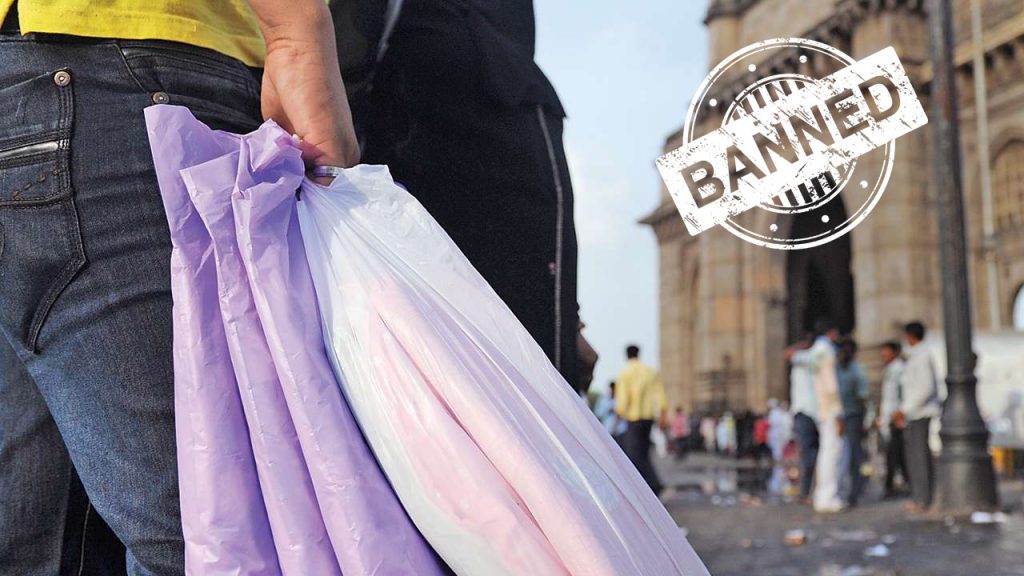
banned plastic

Maharastra Bans All Plastic From 18 March

All the small and medium-scale industries and big industries which are involved in plastic businesses would be provided an adequate time frame to switch over to alternative modes of businesses.

The Maharashtra government has taken the decision to ban the use of plastic in two phases, a notification for which will be issued soon. The decision was taken at the cabinet meeting led by Chief Minister Devendra Fadnavis on Thursday night. The government cited environmental and public health concerns for taking the significant step which would be strictly enforced in a time-bound manner.

Earlier, State Environment Minister Ramdas Kadam had said the ban would be enforced on March 18. A senior cabinet minister requesting anonymity said: “The government has taken the decision to get rid of use of plastic in two phases. A short-term and a long-term policy have been drafted to tackle the plastic menace.

All the small and medium-scale industries and big industries which are involved in plastic businesses would be provided an adequate time frame to switch over to alternative modes of businesses. Various business models have been recommended by the government along with employment to the people engaged in the plastic industries.”

The state environment department has conveyed that the ban would be for all polythene bags, specified type of plastic sheets, flags, flexes and banners, plastic and thermocol items such as plates, cups, glasses, forks, bowls and spoons.

The supply of milk in plastic bags will have to be replaced with environmental friendly containers or bottles. Gradually, all types of food supply which is packaged in plastic will have to be replaced with environment friendly containers and boxes. Cloth bags, bio-degradable containers, bottles, plates, cups and others items would be promoted to help plastic industry to explore alternative business.

The decision will be enforced across rural and urban Maharashtra. All municipal corporations, municipal councils, district collectors and chief executive officers of the zilla parishads have been sensitised to ensure its implementation in their respective regions.

The government also intends to provide some incentives to those who strictly adhere to the ban decision. There is also a proposal to slap a penalty such as non-renewing of licences for shops and industries which violate the decision.

Ravi Jashnani, president of the Maharashtra Plastic Manufacturing Association, said, “Merely banning plastic is not the solution. Even in the past, the government had banned plastic bags below 50 microns. However, it is available in the illegal market. Even this time around, banning plastic will only create a second market for illegal bags, causing losses to the government.”

You may also like

Search the website

Like us on Facebook

Get daily updates via Email

Enter your email address:

Recent Posts

Jamai Shashthi 2026 — The Story of Maa Shashthi, the Cat, and the Wife Who Was Forgiven

Jamai Shashthi 2026 — The Story of Maa Shashthi, the Cat, and the Wife Who Was Forgiven

On Saturday, June 20, 2026, Bengali households across Bharata will welcome their married daughters and sons-in-law home for the legendary jamai-aador feast and perform the Shashthi Vrata. But behind the warmth lies a story most Bengalis know by heart and most non-Bengalis have never heard — the wife who stole the hilsa, blamed the cat, lost six sons to Maa Shashthi’s wrath, and was finally forgiven. The Vrat Katha, the vidhi, the mantras, and the deeper teaching.

Vat Purnima 2026 — The Wife Who Argued Yama Into Returning Her Husband’s Life

On Monday, June 29, 2026, women across Maharashtra, Gujarat, and southern Bharata will tie red thread around banyan trees and hear the story of Savitri — the wife who walked behind Yamaraja Himself when He came for her husband, and out-argued the Lord of Dharma into returning Satyavan’s life. The Mahabharata’s Pativrata Mahatmya Parva, the vrat vidhi, and why the banyan witnessed everything.

Nija Jyeshtha 2026 — The Real Jyeshtha Begins, and the Calendar Resumes

Nija Jyeshtha 2026 — The Real Jyeshtha Begins, and the Calendar Resumes

With Adhik Maas now closed on the Somvati Amavasya of June 15, the long-postponed festivals of Jyeshtha return — Vat Purnima (June 29, the Savitri-Yamaraja katha), Jamai Shashthi (June 20, the Bengali festival of Maa Shashthi), Sankashti Chaturthi (June 28), Yogini Ekadashi (July 10), and Devshayani Ekadashi (July 16, opening the four-month Chaturmas of Bhagavan Vishnu’s yoga-nidra). A guide to what the next four weeks hold and what the household that kept Purushottam Maas now carries forward.

The Closing of Purushottam Maas 2026 — Adhik Amavasya and the Sealing of the Month-Long Vrat

On Monday, June 15, 2026 — a rare Somvati Amavasya — the intercalary month that bears Bhagavan Vishnu’s own name comes to its close. The Acharyas teach that a vrat is not measured by its duration but by its closing. Here are the Padma Purana’s instructions for sealing the month-long Purushottam Maas vrat: the morning snan, the closing puja with the Vishnu Sahasranama, the day of dana, the Somvati Amavasya gift, and the final sarva-arpana — the offering of all merit at the feet of the Lord.

Parama Ekadashi 2026 — The Other Rare Ekadashi of Purushottam Maas, and the Poor Brahmin Who Kept It

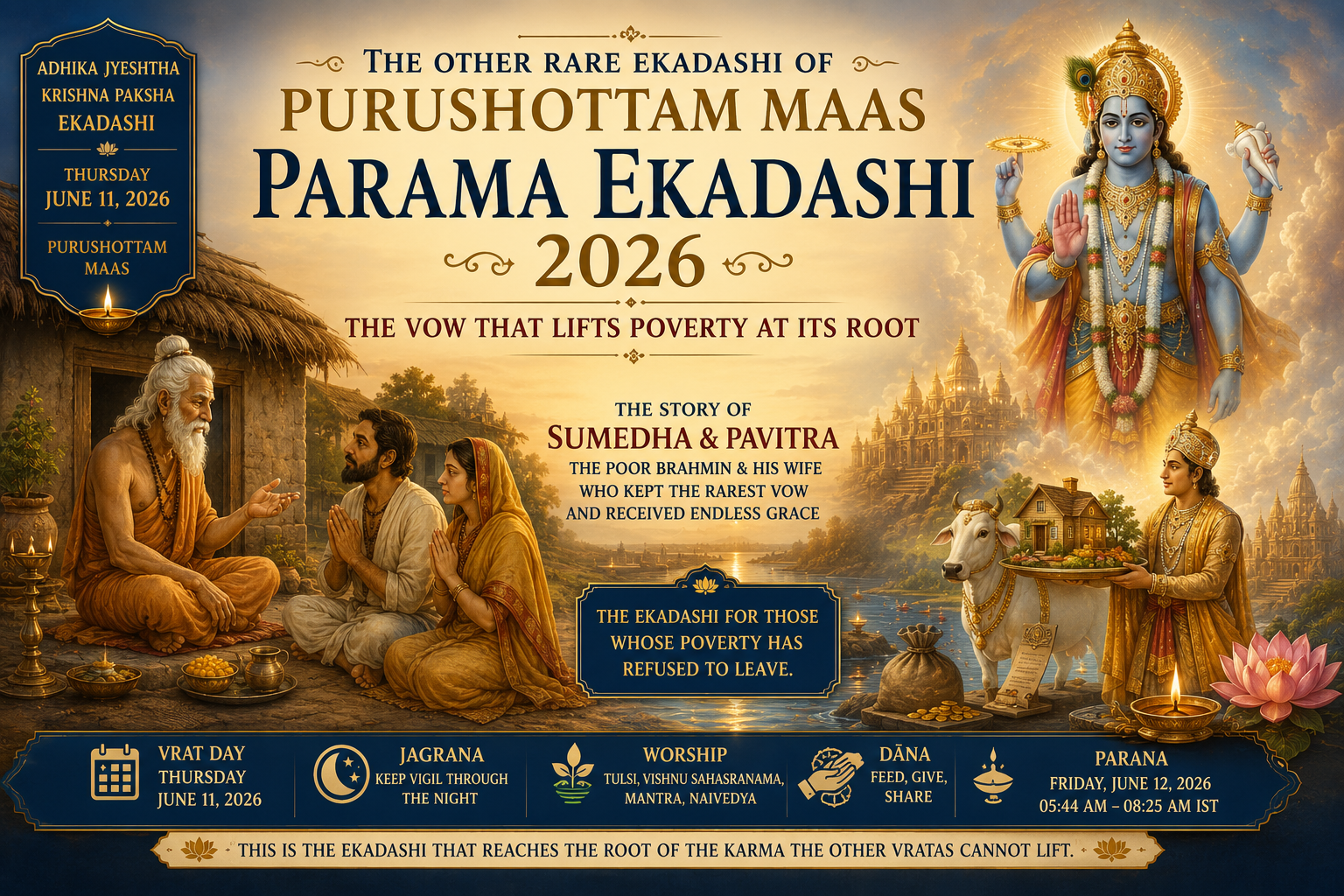
Two weeks ago, Vaishnavas across Bharata kept Padmini Ekadashi — the rare Shukla Paksha Ekadashi of Adhik Maas. Padmini has a twin. On Thursday, June 11, 2026, the Krishna Paksha Ekadashi of the same intercalary month appears: Parama — the Supreme Ekadashi. The Padma Purana names it the rarer and more secret of the two, and reserves it for those whose poverty or sorrow has refused to lift in spite of every other vrat already kept. The story of Sumedha and Pavitra of Kampilya, the rishi Kaundinya, the prince sent by Bhagavan Brahma — and the vidhi for the day.

css.php