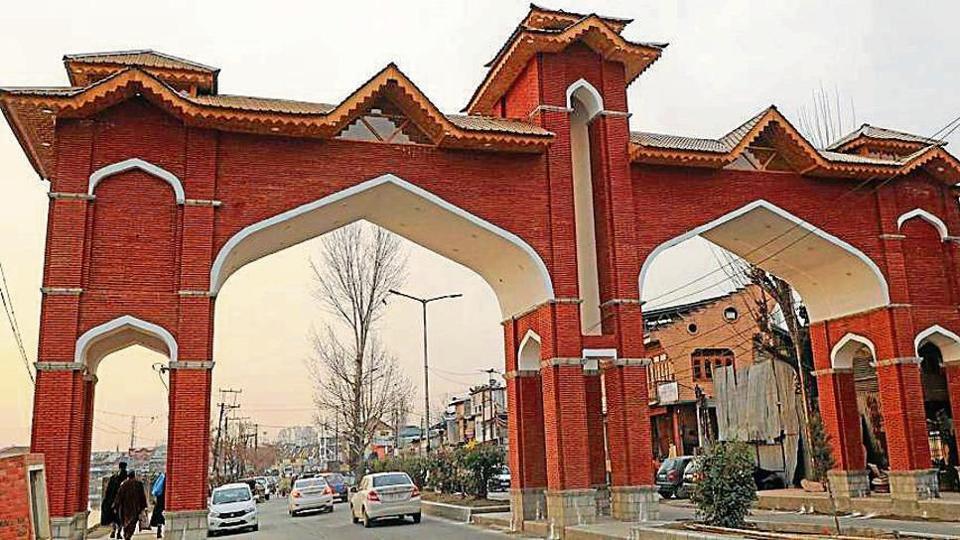
Kashmir: Named Babul-Iqbal after the famous poet of the subcontinent Sir Muhammad Iqbal, it took over six years to complete the gateway at Baba Demb overlooking Brari Nambal lagoon to its west.
An imposing double-arched concrete gateway has come up to demarcate Kashmir’s famed ‘Old City’ or Shehr-e-Khaas in Srinagar. The gateway, with its brick claddings and intricate woodwork, has been constructed at the entrance of the heritage city where people started settling more than 1,500 years ago. It echoes the feel of the cultural monuments and historical spots one can catch a glimpse of once inside Shehr-e-Khaas.
“Downtown Srinagar or ‘Old City’ is really the one with great history and heritage,” said Shafat Ahmad Khan, executive engineer of Srinagar Municipal Corporation, which raised the structure. Old City is famous for its Sufi shrines, mausoleums, a series of bridges over Jhelum, mosques, temples and the places where agitations against autocracy first took place. The ambience of the old structures transports one into the pages of history.
Named Babul-Iqbal after the famous poet of the subcontinent Sir Muhammad Iqbal, it took over six years to complete the gateway at Baba Demb overlooking Brari Nambal lagoon to its west.
Local MLA Ali Mohammad Sagar, who conceived of the idea, said Shehr-e-Khaas was the “quintessence” of Kashmir and has long been a cradle of saints, legends and artists.
A segregation of the city
The construction has not only physically segregated Srinagar into ‘downtown’ — the part where the Old City is — and ‘uptown’ but has also divided the opinion of its residents. While some people feel that the gateway will enhance the heritage value of the Old City and attract more tourists, others have been skeptical owing to the routine restrictions imposed on the movement of people living there.
A young cartoonist Suhail Naqshbandi of a local newspaper expressed the irony by sketching the gateway covered with concertina wires and two big locks. Authorities have been imposing restrictions in the Old City by laying concertina wires just metres ahead of the place where the gateway was laid.
Moderate separatist Mirwaiz Umar Farooq, who is the chief priest of Jamia Masjid and has a good following in the Old City, called the construction a “cosmetic measure”. “‘Attracting’ people to downtown by building some gateway, while for decades resorting to vengeful and dictatorial measures of repeatedly subjecting its residents to curfews, restrictions, harassment and what not! Cosmetic measures without addressing the basic issue will not yield much,” he tweeted.
While MLA Sagar sounded more optimistic and called the gateway a ‘positive step’ for the people of Old City, who have been feeling ‘isolated’. “Now it is up to others to take it forward,” he added.
Rashid Maqbool, a researcher and a Shehr-e-Khaas resident, said that the concept of gated cities in Srinagar is not new. “We had Nagar Nagar in the Old City, which was a walled city with two gates,” he said.
Maqbool said that the gateway has a “cultural and symbolic value” as the city, in the past 50 years, has now shifted to Lal Chowk and adjoining areas (uptown). “There was no clear-cut demarcation into Old City and our young generation would not know where it starts. They will now get a feel of entering history. It has that fanciful and romantic idea in our minds,” he said.
Once the capital
Professor and historian Mohammad Ashraf Wani said that though Srinagar was established as the capital by Ashoka in 300 BC at Pandrethan region, it was later shifted to Shehr-e-Khaas by Raja Parversena, who named it Parverpur, in the 6th century AD. Its development received an impetus during the Mughal rule. In his opinion though, the gateway should have been constructed further ahead at Dalgate from where the Old City actually started.
Yawar Lone, an MBA hotelier who lives near the gateway, is very enthusiastic about the new structure. “It is the best thing to happen here. It is a gift to Shehr-e-Khaas. Like there is Gateway of India in Mumbai, we now have Babul-Iqbal for Srinagar. All I want is that the government should market it properly so that more tourists visit here,” Lone said.
While the locals also complained that the shops of scrap dealers and joineries around the area have marred its beauty, SMC executive engineer Shafat Ahmad Khan said that a further facelift would happen in due course of time.