IndianSanskriti
Haryana-cabinet-nod-to-death-penalty-for-rape-of-victim-aged-12-or-less

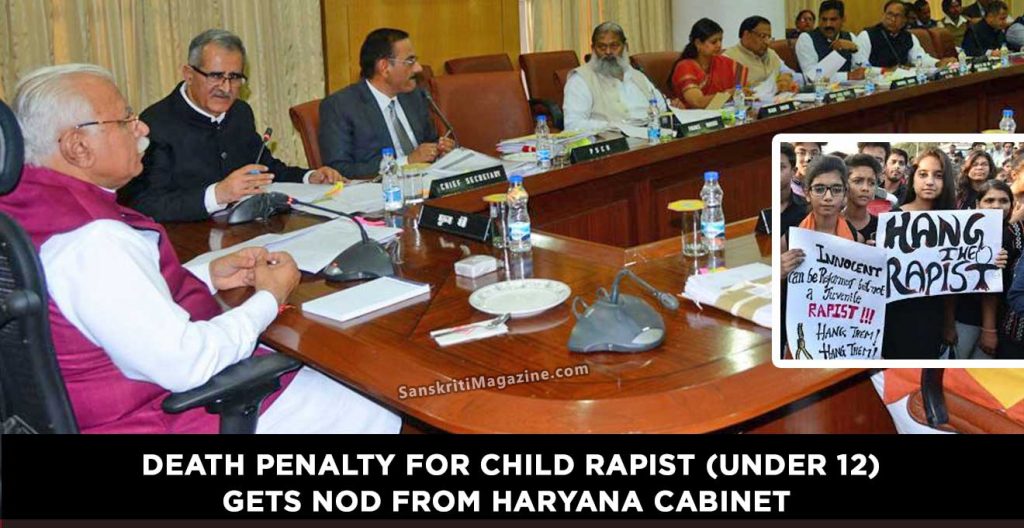
Death penalty for child rapist (under 12) gets nod from Haryana cabinet

The cabinet decided that in case of rape or gangrape of a girl upto 12 years of age, there will be a punishment of death or rigorous imprisonment of not less than 14 years which may extend to imprisonment for life

The Haryana government on Tuesday gave its nod to a proposal to bring in a legislation that would have a provision awarding death penalty to those guilty of raping girls aged 12 years or less.

In a meeting of the state Cabinet headed by chief minister Manohar Lal Khattar, it was also decided to make the existing criminal laws related to sexual offences more stringent.

The Haryana Cabinet, which met under the chairmanship of CM Khattar here today, decided to amend legal provisions like section 376A (Intercourse by a man with his wife during separation), 376D (rape by one or more persons constituting a group), 354 (Assault or criminal force against woman with intent to outrage her modesty) and 354 D(2) (stalking) of Indian Penal Code (IPC).

In case of rape or gangrape of a girl upto 12 years of age, there will be a punishment of death or rigorous imprisonment of not less than 14 years which may extend to imprisonment for life that is for remainder period of person’s natural life, the Cabinet decided, an official release said.

Another provision approved is under section 376D A of the IPC, where a girl upto 12 years of age is raped by one or more persons constituting a group, each of those persons shall be deemed to have committed the offence of rape and will be punished with death or rigorous imprisonment for a term which will not be less than 20 years, but which may extend to life along with a fine, the release said.

“Such a fine shall be just and reasonable to meet the medical expenses and rehabilitation of the victim. Any fine imposed under this section will be paid to the victim,” the release said.

According to the proposal that received the state cabinet’s nod, the punishment under section 354 of the IPC will not be less than two years (earlier not less than one year) but may extend upto seven years (earlier upto five years) and shall also liable to fine.

Also, under section 354D (2) of the IPC, whoever commits the offence or stalking will be punished on first conviction with imprisonment of either description for a term which may extend to three years and be punished on a second or subsequent conviction, with imprisonment for not less than three years, but which may extend to seven years (earlier up to five years), the statement said.

Significantly, chief minister Khattar, who had expressed anguish and concern over recent incidents of rape, had said that provisions of “harsher punishment for rape” were required in the state

You may also like

Search the website

Like us on Facebook

Get daily updates via Email

Enter your email address:

Recent Posts

Yogini Ekadashi 2026 — The Yaksha Who Missed the Morning Flowers, and the Ekadashi That Undid His Curse

On Friday, July 10, 2026, the rare Krishna Paksha Ekadashi of Nija Ashadha arrives. The Padma Purana tells the story of Hemamali — the Yaksha gardener of Bhagavan Kubera in Alaka, whose single morning of distraction with his wife Vishalakshi cost him his form, his wife, and his celestial city. Cursed to wander the earth of Bharata as a leper for a long time, he was at last shown the way back by Sage Markandeya — a single sincere keeping of Yogini Ekadashi.

Jamai Shashthi 2026 — The Story of Maa Shashthi, the Cat, and the Wife Who Was Forgiven

Jamai Shashthi 2026 — The Story of Maa Shashthi, the Cat, and the Wife Who Was Forgiven

On Saturday, June 20, 2026, Bengali households across Bharata will welcome their married daughters and sons-in-law home for the legendary jamai-aador feast and perform the Shashthi Vrata. But behind the warmth lies a story most Bengalis know by heart and most non-Bengalis have never heard — the wife who stole the hilsa, blamed the cat, lost six sons to Maa Shashthi’s wrath, and was finally forgiven. The Vrat Katha, the vidhi, the mantras, and the deeper teaching.

Vat Purnima 2026 — The Wife Who Argued Yama Into Returning Her Husband’s Life

On Monday, June 29, 2026, women across Maharashtra, Gujarat, and southern Bharata will tie red thread around banyan trees and hear the story of Savitri — the wife who walked behind Yamaraja Himself when He came for her husband, and out-argued the Lord of Dharma into returning Satyavan’s life. The Mahabharata’s Pativrata Mahatmya Parva, the vrat vidhi, and why the banyan witnessed everything.

Nija Jyeshtha 2026 — The Real Jyeshtha Begins, and the Calendar Resumes

Nija Jyeshtha 2026 — The Real Jyeshtha Begins, and the Calendar Resumes

With Adhik Maas now closed on the Somvati Amavasya of June 15, the long-postponed festivals of Jyeshtha return — Vat Purnima (June 29, the Savitri-Yamaraja katha), Jamai Shashthi (June 20, the Bengali festival of Maa Shashthi), Sankashti Chaturthi (June 28), Yogini Ekadashi (July 10), and Devshayani Ekadashi (July 16, opening the four-month Chaturmas of Bhagavan Vishnu’s yoga-nidra). A guide to what the next four weeks hold and what the household that kept Purushottam Maas now carries forward.

The Closing of Purushottam Maas 2026 — Adhik Amavasya and the Sealing of the Month-Long Vrat

On Monday, June 15, 2026 — a rare Somvati Amavasya — the intercalary month that bears Bhagavan Vishnu’s own name comes to its close. The Acharyas teach that a vrat is not measured by its duration but by its closing. Here are the Padma Purana’s instructions for sealing the month-long Purushottam Maas vrat: the morning snan, the closing puja with the Vishnu Sahasranama, the day of dana, the Somvati Amavasya gift, and the final sarva-arpana — the offering of all merit at the feet of the Lord.

css.php