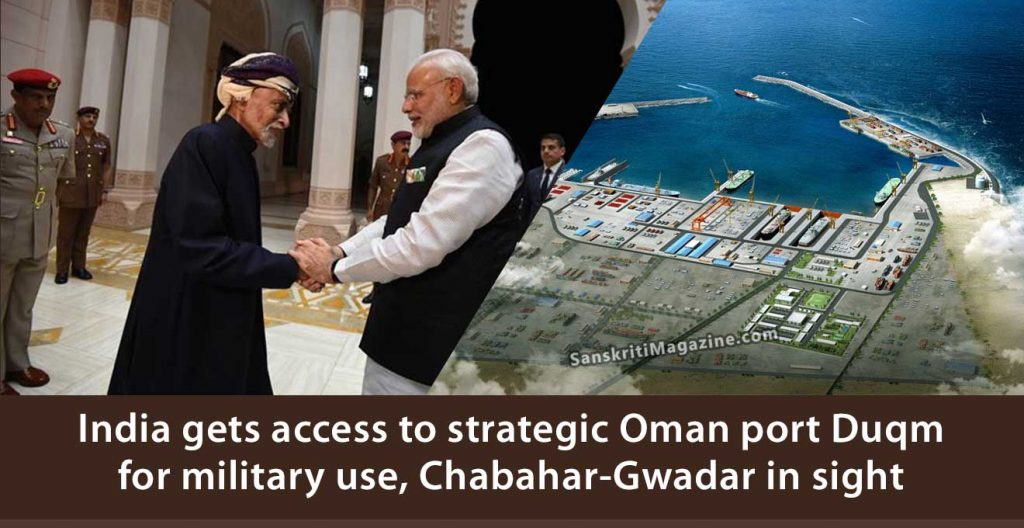
This is part of India’s maritime strategy to counter Chinese influence and activities in the region. This was one of the key takeaways of Prime Minister Narendra Modi’s visit to Oman over the last two days.
In a strategic move to expand its footprint in the Indian Ocean region, India has secured access to the key Port of Duqm in Oman for military use and logistical support, top sources have told The Indian Express. This is part of India’s maritime strategy to counter Chinese influence and activities in the region. This was one of the key takeaways of Prime Minister Narendra Modi’s visit to Oman over the last two days. He met Sultan of Oman Sayyid Qaboos bin Said Al Said and an annexure to the Memorandum of Understanding on Military Cooperation was signed between the two countries. Sources said following this pact, the services of Duqm port and dry dock will be available for maintenance of Indian military vessels.
The Port of Duqm is situated on the southeastern seaboard of Oman, overlooking the Arabian Sea and the Indian Ocean. It is strategically located, in close proximity to the Chabahar port in Iran. With the Assumption Island being developed in Seychelles and Agalega in Mauritius, Duqm fits into India’s proactive maritime security roadmap.
Recently, Duqm has seen a rise in Indian activities. In September last year, India deployed an attack submarine to this port in the western Arabian Sea. A Shishumar-class submarine entered Duqm along with naval ship INS Mumbai and two P-8I long-range maritime patrol aircraft. India gets access to strategic Oman port for military use, reconnaissance aircraft. The naval units were on a month-long deployment with the aim of enhancing surveillance and cooperation.
Following Modi’s visit to Oman, the joint statement said the two sides noted that the MoU on Military Cooperation, signed in 2005 and renewed in 2016, has provided the general framework to strengthen bilateral defence ties. India and Oman noted that the MoUs on cooperation in maritime security and between Coast Guards of the two countries, signed in May 2016, have provided a firm foundation for deepening institutional interactions. “Both sides expressed satisfaction at the signing of an annexure to the existing MoU on Military Cooperation between the defence ministries,” it said.
In August 2017, Oman signed an MoU with the United Kingdom that allowed the Royal Navy to use the Port of Duqm. The agreement allows UK access to facilities at Duqm, and among the vessels that will be allowed to dock at the port is the HMS Queen Elizabeth aircraft carrier, the largest ship in the British Navy.
The joint statement said the Indian side thanked Oman for facilitating operational visits by Indian Naval ships and aircraft as well as Indian Air Force aircraft to various ports and airports. “Recognising their common responsibility towards promoting regional peace and security, the two sides underlined the importance of further cementing bilateral strategic engagement, especially in the areas of security and defence,” it said.
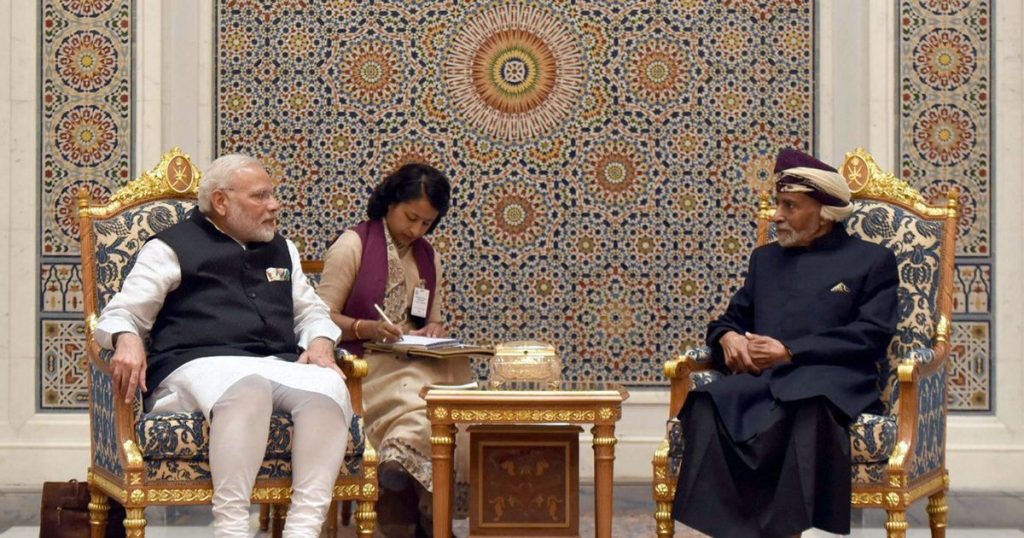
It also said that the two sides expressed satisfaction at the ongoing bilateral security collaboration in the fields of counter-terrorism, information-sharing and capacity-building, and the Prime Minister appreciated the support extended by Omani security agencies on “specific issues of security concern to India”.
They agreed to provide further impetus to the robust defence relations, including through regular joint exercises by the three defence forces, training of Navy, Air and Army officials, as also cooperation in the area of coastal defence and through participation in defence exhibitions, the statement said.
The Port of Duqm also has a special economic zone, where about $1.8 billion investments are being made by some Indian companies. The Adani group had signed an MoU with Duqm port authorities last year, but no investments have been made so far. “The Prime Minister expressed his admiration at the ongoing efforts and plans the Sultanate of Oman is making to diversify its economy and welcomed the invitation to Indian companies to invest in various sectors in the special economic zones of Oman, including SEZs in Duqm, Sohar and Salalah. He offered India’s partnership and cooperation in areas of priority, such as minerals and mining, manufacturing, logistics, infrastructure, tourism, agriculture and fisheries, IT and IT enabled-services, skills development, innovation,” said the joint statement.
In the context of strategic oil reserves near Duqm, it said the Prime Minister reiterated India’s invitation to Oman to participate in building strategic oil reserves in India. “Sultan briefed the Indian Prime Minister on Oman’s own initiative to create its strategic oil reserves in Ras Markaz near Duqm. The two sides agreed that there is broad scope for mutual cooperation in building their strategic oil reserves,” the statement said.
Besides Sultan Qaboos, the Prime Minister met Deputy Prime Minister Sayyid Fahd bin Mahmoud al-Said, and Deputy Prime Minister for International Relations and Cooperation Affairs Sayyid Asa’ad bin Tariq Al Said.
He also visited a Shiva temple and the Grand Mosque, besides addressing the business community, before leaving for Delhi. During his meeting with Modi, Sultan Qaboos shared his views on turmoil in the region, especially in Yemen. The Prime Minister thanked him for his efforts in securing the release of captured priest, Father Tom, from Yemen last year.
“The two sides acknowledged the common threat posed by terrorism to peace and security and agreed to continue working together bilaterally, regionally and globally to counter this menace. They reiterated their strong condemnation of terrorism in all its forms and manifestations, wherever committed and by whomever, and declared that there could be no justification for any act of terrorism anywhere,” said the joint statement.
The two sides also emphasised the need to “isolate the sponsors and supporters of terrorism” and agreed that the international community should take urgent action against all entities which support terrorism and use it as an instrument of policy.