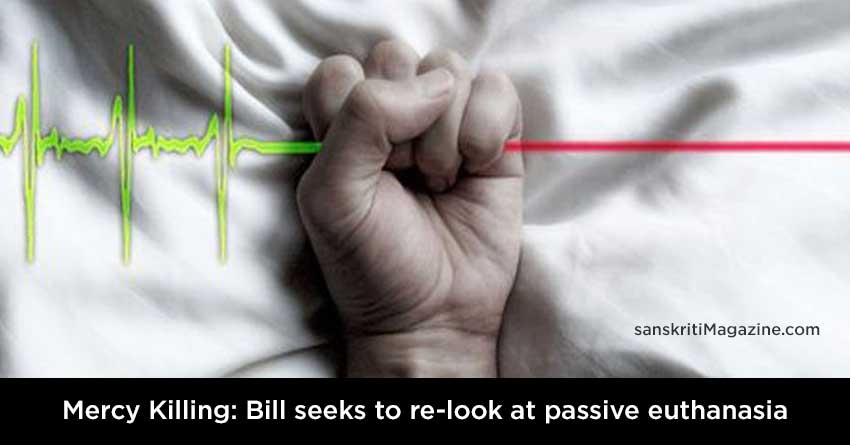
NEW DELHI: Addressing the contentious issue of mercy killing, the government has come up with a draft Bill on passive euthanasia which will give a patient the right to withhold from medical treatment in case they are terminally ill.
The Union Health Ministry has drafted and put up ‘The Medical Treatment of Terminally Ill Patients (Protection of Patients and Medical Practitioners) Bill’ in the public domain for consultation with stakeholders.
The Bill intends to provide protection to patients and medical practitioners from liability in the context of withholding or withdrawing medical treatment, including life support systems, from those who are terminally ill. According to the Bill, every “competent” person, including minors aged over 16, has a right to decide on withholding or withdrawing medical treatment and to allow nature to take its own course or for starting medical treatment in case of terminal illness.
The Bill goes on to say that such a decision will be binding on the medical practitioner. He or she has to inform the spouse, parents or any other close relative of the patient and desist from carrying out the decision for a period of three days after informing them.
However, despite withdrawing the medical treatment, the said doctor can keep administering palliative care to the patient. The draft Bill gives legal cover to both patients and medical practitioners.
The Medical Council of India has been given the authority to formulate guidelines from time to time for the guidance of medical practitioners and might review and modify the guidelines periodically.
In case any patient is not competent enough to take a decision then his or her next of kin, including spouse, parents or sibling, can approach the High Court, which will have to take a decision within a period of one month.
 The government first attempted to formulate a law in 2006, based on a report of the Law Commission. However, the ministry had at that time decided not to take any action. The Supreme Court had laid down comprehensive guidelines in the Aruna Shanbaug case to process passive euthanasia. Active euthanasia is different from the passive form and involves injecting the patient with a lethal substance causing death in a painless manner.
The Aruna Shanbaug story
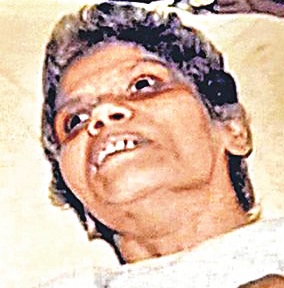
The debate on euthanasia caught the public attention in Aruna Shanbaug’s case. Aruna died in 2015 after being in a Permanent Vegetative State for over 40 years. While rejecting the plea for her mercy killing, SC laid out the first set of guidelines for euthanasia
What happened to Aruna?
Aruna, a nurse at King Edward Memorial Hospital in Mumbai, was sexually assaulted by a sweeper in 1973. He choked her with a dog chain causing severe brain damage. She was discovered only the next day