IndianSanskriti
1,000-years-old-Hindu-temple-discovered-in-Indonesia

1,000-years old Ancient Hindu Temple discovered in Indonesia

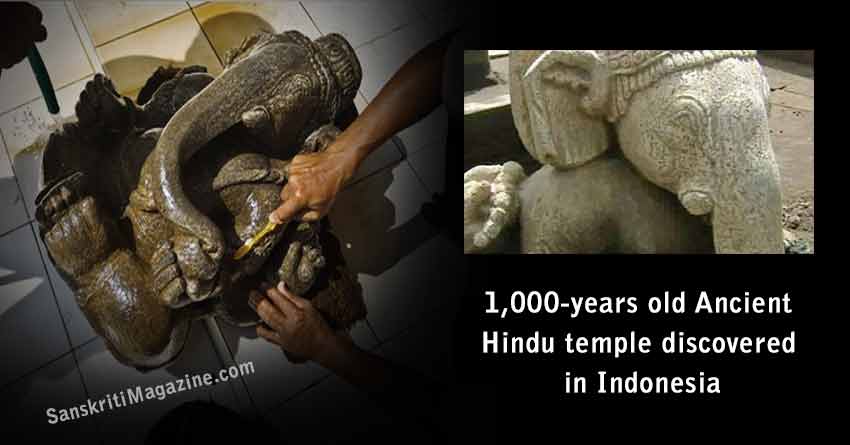
Archaeologists in Indonesia have uncovered a 1,000-year-old temple that could shed light on the country’s Hindu past. The intricately carved statues and reliefs are some of the best preserved in Indonesia, but the dig is being conducted under tight security to protect the site from well-organized relic thieves.The temple was found on the grounds of Yogyakarta’s Islamic University as workers probed the ground to lay foundations for a new library, and they realized the earth beneath their feet was not stable.

Digging soon revealed an extraordinary find: three meters underground were still-standing temple walls. Heavy rains then exposed the top of a statue of the god Ganesha in pristine condition. A few weeks into the excavation, archaeologists are declaring the temple and its rare and beautiful statues an important discovery that could provide insights into Indonesia’s pre-Islamic culture.

“This temple is a quite significant and very valuable because we have never found a temple as whole and intact as this one,” said archaeologist Dr Budhy Sancoyo, who is one of the researchers painstakingly cleaning up the temple.”For example, looking at where the statues are placed in this temple, they are in their original positions, unlike the other temples.

“This temple is important for understanding the culture of our ancestors.”A volcanic eruption is thought most likely to have covered the temple around the 10th century, about 100 years after it was built.
The eruption preserved its statues and reliefs in better condition than almost everything else discovered in Indonesia from that period, including the Borobodur and Prambanan temple complexes. But now that they are exposed, the temple’s contents need to be protected with 24-hour security. Last November, thieves plundered the nearby Plaosan Temple.

The heads of two rare Buddhist statues were stolen, to be traded by organized syndicates dealing in artifacts.Tri Wismabudhi from central Java’s culture and heritage agency says temple thieves are robbing Indonesians of a piece of their history.”To us, archaeological sites like this are archaeological data, so if the data is missing or incomplete, that means the history of the nation is also missing,” he said.”People don’t understand that. That’s why they steal, because they don’t realise how important this is for us as a nation.”

At the Kimpulan temple on the campus of Yogyakarta’s Islamic University, the statue of Ganesha is being kept slightly buried to make it harder to steal.It could sell for up to $250,000 on the black market. The university wants to open the site to the public once the dig is complete. The library that was destined for the site will be redesigned to incorporate the Hindu temple.


Via

You may also like

Search the website

Like us on Facebook

Get daily updates via Email

Enter your email address:

Recent Posts

Yogini Ekadashi 2026 — The Yaksha Who Missed the Morning Flowers, and the Ekadashi That Undid His Curse

On Friday, July 10, 2026, the rare Krishna Paksha Ekadashi of Nija Ashadha arrives. The Padma Purana tells the story of Hemamali — the Yaksha gardener of Bhagavan Kubera in Alaka, whose single morning of distraction with his wife Vishalakshi cost him his form, his wife, and his celestial city. Cursed to wander the earth of Bharata as a leper for a long time, he was at last shown the way back by Sage Markandeya — a single sincere keeping of Yogini Ekadashi.

Jamai Shashthi 2026 — The Story of Maa Shashthi, the Cat, and the Wife Who Was Forgiven

Jamai Shashthi 2026 — The Story of Maa Shashthi, the Cat, and the Wife Who Was Forgiven

On Saturday, June 20, 2026, Bengali households across Bharata will welcome their married daughters and sons-in-law home for the legendary jamai-aador feast and perform the Shashthi Vrata. But behind the warmth lies a story most Bengalis know by heart and most non-Bengalis have never heard — the wife who stole the hilsa, blamed the cat, lost six sons to Maa Shashthi’s wrath, and was finally forgiven. The Vrat Katha, the vidhi, the mantras, and the deeper teaching.

Vat Purnima 2026 — The Wife Who Argued Yama Into Returning Her Husband’s Life

On Monday, June 29, 2026, women across Maharashtra, Gujarat, and southern Bharata will tie red thread around banyan trees and hear the story of Savitri — the wife who walked behind Yamaraja Himself when He came for her husband, and out-argued the Lord of Dharma into returning Satyavan’s life. The Mahabharata’s Pativrata Mahatmya Parva, the vrat vidhi, and why the banyan witnessed everything.

Nija Jyeshtha 2026 — The Real Jyeshtha Begins, and the Calendar Resumes

Nija Jyeshtha 2026 — The Real Jyeshtha Begins, and the Calendar Resumes

With Adhik Maas now closed on the Somvati Amavasya of June 15, the long-postponed festivals of Jyeshtha return — Vat Purnima (June 29, the Savitri-Yamaraja katha), Jamai Shashthi (June 20, the Bengali festival of Maa Shashthi), Sankashti Chaturthi (June 28), Yogini Ekadashi (July 10), and Devshayani Ekadashi (July 16, opening the four-month Chaturmas of Bhagavan Vishnu’s yoga-nidra). A guide to what the next four weeks hold and what the household that kept Purushottam Maas now carries forward.

The Closing of Purushottam Maas 2026 — Adhik Amavasya and the Sealing of the Month-Long Vrat

On Monday, June 15, 2026 — a rare Somvati Amavasya — the intercalary month that bears Bhagavan Vishnu’s own name comes to its close. The Acharyas teach that a vrat is not measured by its duration but by its closing. Here are the Padma Purana’s instructions for sealing the month-long Purushottam Maas vrat: the morning snan, the closing puja with the Vishnu Sahasranama, the day of dana, the Somvati Amavasya gift, and the final sarva-arpana — the offering of all merit at the feet of the Lord.

css.php