“Because tobacco is responsible for an impressive one-third of cancers.” – Bernard Levin
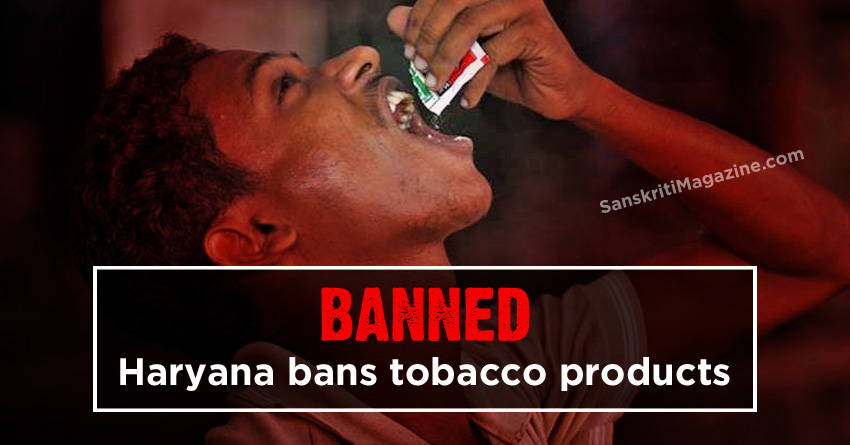
Considering the harmful health effects of tobacco, the Haryana government on Tuesday, September 8, completely banned manufacture and sale of all the products containing tobacco in the state. State Food and Drugs Administration has also issued a notification regarding the same. Violation of the ban is punishable with imprisonment up to six months or fine up to 1 lakh rupees.
Here are some facts on the recent ban on the tobacco products in Haryana:
- The ban includes manufacturing, distribution, storage and sale of the tobacco products
- The tobacco products include gutka, pan masala, flavoured or scented tobacco, kharra and other similar products containing tobacco
- The ban also includes mix of other ingredients such as heavy metals and anti-caking agents except the specifically permitted such as silver leaf, binders, flavours, scents, and fragrances
- These substances were banned due to presence of Nicotine which already has been added by state government in the list of poisonous substances
- Other tobacco products containing tobacco which are available in market are also included in it
- Other items in the list are: Acetic acid, Sulphuric Acid, Hydrochloric Acid, Phosphoric Acid, Hydrofluoric acid, Perchloric acid, Formic acid, Hydrocyanic acid, Nitric Acid, Oxylic Acid, Potassium Hydroxide, Sodium Hydroxide, Hydrogen Peroxide, Formaldehyde and Phenol.
Some facts on the tobacco ban in India:
1. Prohibition of sale of tobacco products in an area within 100 yards of any educational institution was brought into force on December 1, 2004.
2. In 2007, Chandigarh became the first city in India to become ‘smoke-free’. The architect of smoke-free Chandigarh, Hemant Goswami, was also awarded the Global Smoke-Free Partnership Award for the initiative.
3. Shimla also followed the Smoke-Free Chandigarh model to become smoke-free.
4. A rule to ban smoking in public places was instituted nationwide October 2, 2008 under the Prohibition of Smoking in Public Places Rules, 2008.
5. Places where smoking is restricted include auditoriums, cinemas, hospitals, public transport (aircraft, buses, trains, metros, monorails, taxis) and their related facilities (airports, bus stands/stations, railway stations), restaurants, hotels, bars, pubs, amusement centres, offices (government and private), libraries, courts, post offices, markets, shopping malls, canteens, refreshment rooms, banquet halls, discothèques, coffee houses, educational institutions and parks.
6. Rules mandating pictorial warnings on tobacco products were first notified on May 3, 2009 and came into force on May 31, 2009
7. The government began screening two anti-tobacco advertisements, titled “Sponge” and “Mukesh”, in movie theatres and on television from October 2, 2012
8. It is also mandatory for theatres to display a disclaimer on-screen whenever smoking scenes are depicted in the movie.
Tobacco is injurious to health. Say NO to tobacco.