IndianSanskriti
money-printing

Indian Government to save Rs 1,500 crore from new note printing lines

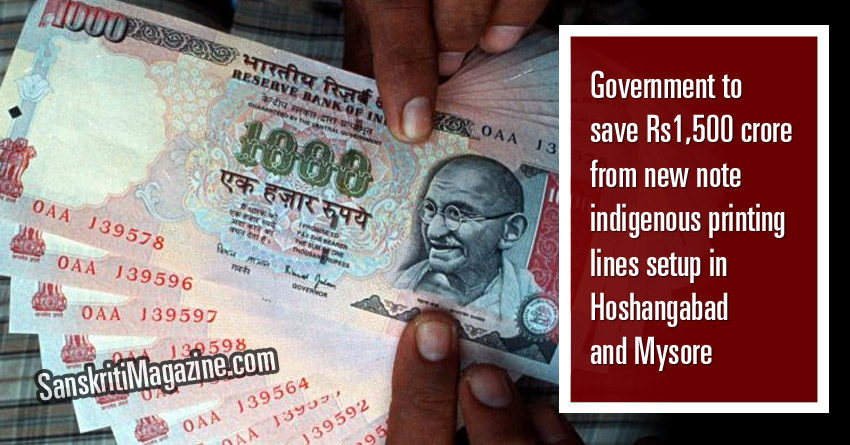
The Indian Government is expected to saveforeign exchange worth Rs 1,500 crore by commissioning two new bank paper lines in Hoshangabad and Mysore for indigenously printing Indian currency.

The New Bank Note Paper Line of 6,000 metric tonnes (MT) capacity at Security Paper Mill (SPM), Hoshangabad in Madhya Pradesh will be inaugurated tomorrow by Finance Minister Arun Jaitley, while the Bank Note Paper Line in Mysore with 12,000 MT capacity is expected to be commissioned by the year end.

“The combined savings of foreign exchange from these two Bank Note projects will be about Rs 1,500 crore in the coming years,” a finance ministry said in a statement.

The production of the Bank Note paper from these two units will reduce the import considerably, it said.

This will also reduce possibility of diversion of the paper supplied by the foreign suppliers to the other destinations for the purpose of generating the fake currency, it said.

“Commissioning of this project is part of Make-in-India, Indigenisation of Currency and to become self-reliant in production of the raw materials requirement for the production of the Bank Notes,” it said.

At the same time, the Finance Minister will flag off the first consignment of Rs 1,000 Bank Note paper made indigenously for Currency Note Press, Nashik.

Security Printing and Minting Corporation of India Limited (SPMCIL) has also set up another Joint Venture Company called Bank Note Paper Mill India Pvt at Mysore besides SPM, Hoshangabad.

SPMCIL has nine units engaged in minting of coins, printing of banknotes, passports, postal stationery, non-judicial stamp papers, and other security documents & security paper.


You may also like

Search the website

Like us on Facebook

Get daily updates via Email

Enter your email address:

Recent Posts

Yogini Ekadashi 2026 — The Yaksha Who Missed the Morning Flowers, and the Ekadashi That Undid His Curse

On Friday, July 10, 2026, the rare Krishna Paksha Ekadashi of Nija Ashadha arrives. The Padma Purana tells the story of Hemamali — the Yaksha gardener of Bhagavan Kubera in Alaka, whose single morning of distraction with his wife Vishalakshi cost him his form, his wife, and his celestial city. Cursed to wander the earth of Bharata as a leper for a long time, he was at last shown the way back by Sage Markandeya — a single sincere keeping of Yogini Ekadashi.

Jamai Shashthi 2026 — The Story of Maa Shashthi, the Cat, and the Wife Who Was Forgiven

Jamai Shashthi 2026 — The Story of Maa Shashthi, the Cat, and the Wife Who Was Forgiven

On Saturday, June 20, 2026, Bengali households across Bharata will welcome their married daughters and sons-in-law home for the legendary jamai-aador feast and perform the Shashthi Vrata. But behind the warmth lies a story most Bengalis know by heart and most non-Bengalis have never heard — the wife who stole the hilsa, blamed the cat, lost six sons to Maa Shashthi’s wrath, and was finally forgiven. The Vrat Katha, the vidhi, the mantras, and the deeper teaching.

Vat Purnima 2026 — The Wife Who Argued Yama Into Returning Her Husband’s Life

On Monday, June 29, 2026, women across Maharashtra, Gujarat, and southern Bharata will tie red thread around banyan trees and hear the story of Savitri — the wife who walked behind Yamaraja Himself when He came for her husband, and out-argued the Lord of Dharma into returning Satyavan’s life. The Mahabharata’s Pativrata Mahatmya Parva, the vrat vidhi, and why the banyan witnessed everything.

css.php