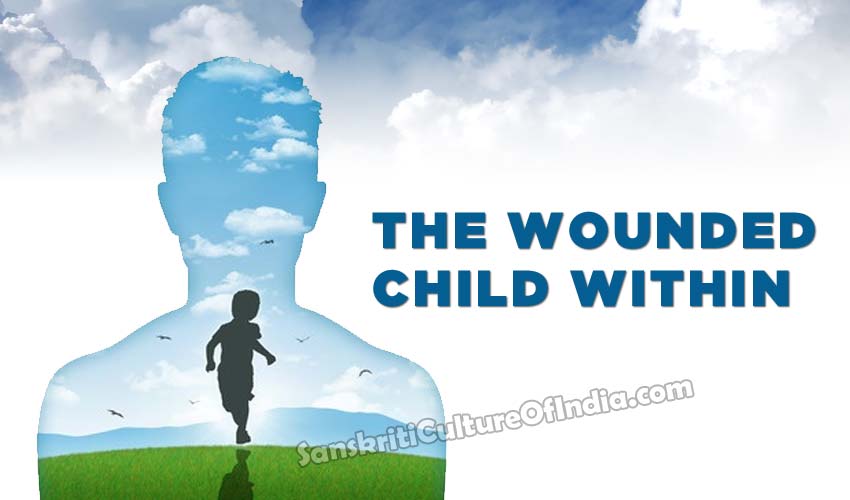
In each of us, there is a young, suffering child. We have all had times of difficulty as children and many of us have experienced trauma. To protect and defend ourselves against future suffering, we often try to forget those painful times. Every time we’re in touch with the experience of suffering, we believe we can’t bear it, and we stuff our feelings and memories deep down in our unconscious mind. It may be that we haven’t dared to face this child for many decades.
But just because we may have ignored the child doesn’t mean she or he isn’t there. The wounded child is always there, trying to get our attention. The child says, “I’m here. I’m here. You can’t avoid me. You can’t run away from me.” We want to end our suffering by sending the child to a deep place inside, and staying as far away as possible. But running away doesn’t end our suffering; it only prolongs it.
When we become aware that we’ve forgotten the wounded child in ourselves, we feel great compassion for that child and we begin to generate the energy of mindfulness. The practice of mindful walking mindful sitting and mindful breathing are our foundation. With our mindful breath and mindful steps, we can product the energy of mindfulness and return to the awakened wisdom lying in each cell of our body. That energy will embrace us and heal us, and will heal the wounded child in us.
The first function of mindfulness is to recognize and not to fight. We can stop at any time and become aware of the child within us. When we recognize the wounded child for the first time, all we need to do is be aware of him or her and say hello. That’s all. Perhaps this child is sad. If we notice this we can just breathe in and say to ourselves, “Breathing in, I know that sorrow has manifested in me. Hello, my sorrow. Breathing out, I will take good care of you.”
Once we have recognized our inner child, the second function of mindfulness is to embrace him or her. This is a very pleasant practice. Instead of fighting our emotions, we are taking good care of ourselves. Mindfulness brings with her an ally – concentration. The first few minutes of recognizing and embracing our inner child with tenderness will bring some relief. The difficult emotions will still be there, but we won’t suffer as much anymore.
After recognizing and embracing our inner child, the third function of mindfulness is to soothe and relieve our difficult emotions. Just by holding this child gently, we are soothing our difficult emotions and we can begin to feel at ease. When we embrace our strong emotions with mindfulness and concentration, we’ll be able to see the roots of these mental formations. We’ll know where our suffering has come from. When we see the roots of things, our suffering will lessen. So mindfulness recognizes, embraces and relieves.
The energy of mindfulness contains the energy of concentration as well as the energy of insight. Concentration helps us focus on just one thing. With concentration, the energy of looking becomes more powerful and insight is possible. Insight always has the power of liberating us. If mindfulness is there, and we know how to keep mindfulness alive, concentration will be there too. And if we know how to keep concentration alive, insight will also come. The energy of mindfulness enables us to look deeply and gain the insight we need so that transformation is possible.
Appropriate Attention:
If we were abused as a seven-year-old, we’ll carry within us an image of that seven-year-old who is vulnerable and full of fear. When we hear something that reminds us of our suffering, it automatically puts us in touch with that old image. Many things that we see, hear and experience in the present moment have the effect of bringing us back to that memory of suffering.
If we have been abused as a child, almost anything we see or hear can bring us back to that image of being abused. Being so constantly in touch with these images of the past can give rise to feelings of fear, anger and despair. We call this “inappropriate attention” (ayoniso manaskara) because it takes us away from the present moment and into a place of old suffering. It’s very important that whenever our attention is brought to that place, to that kind of image, we have ways of dealing with the sorrow, fear and suffering that arise.
The sound of the meditation bell is a reminder for us to stop our thinking and talking and go back to our in-breath and our out-breath. The sound of the bell can take us away from the image of suffering and remind us to enjoy breathing in deeply, calming our body and mind, smiling. When suffering arises, our practice is to breathe in and out and say, “Breathing in, I know that suffering is in me.” Recognizing and embracing the mental formation is our practice. And if we do well, we can go further. With mindfulness and concentration, we can go back to the image and know what has made it arise. I have this because I have been in touch with that.
Many of us can’t get out of the world of images. With the energy of mindfulness, we recognize that our old suffering is only an image; it is not reality. And we can see that life with all its wonders is here, that living happily in the present moment is possible, and then we can change the whole situation.
~ Thich Nhat Hahn