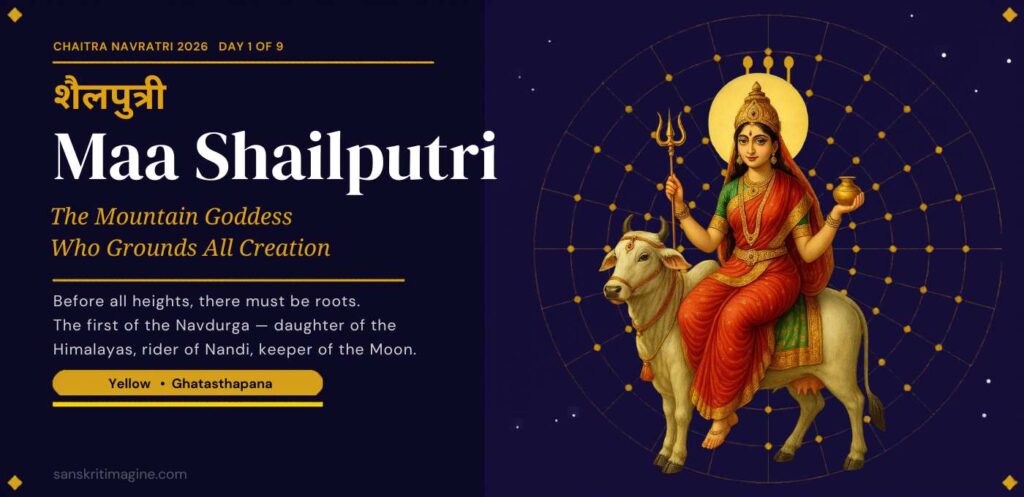
Maa Shailputri
The Mountain Goddess Who Grounds All Creation
There is a particular kind of stillness that belongs to mountains. No storm moves them. No season changes their nature. They simply are — ancient, immovable, and alive with a power that runs deeper than anything visible on the surface. On the first day of Chaitra Navratri, we begin our journey with the goddess who embodies exactly this quality. We begin with Maa Shailputri — the daughter of the mountain, the first of the nine sacred forms of Devi, and the foundation upon which the entire Navratri ascent is built.
Today is no ordinary first day. March 19, 2026 is simultaneously the beginning of Chaitra Navratri, the auspicious day of Ghatasthapana (the ritual invocation of Devi into the home), and the dawn of Vikram Samvat 2083 — the Hindu New Year. In Maharashtra and Karnataka, it is celebrated as Gudi Padwa and Ugadi respectively. That the Hindu New Year begins with the most grounded of all nine Devis is not a coincidence. It is a cosmological teaching: if you wish to rise, you must first know how to stand still.
Who Is Maa Shailputri?
The name Shailputri is derived from two Sanskrit words: Shaila (शैल), meaning mountain or rock, and Putri (पुत्री), meaning daughter. She is, quite literally, the daughter of the mountains — born as the beloved child of Himavat, the king of the Himalayas, and his queen, Mena.
But her story begins long before this birth. In her previous life, Shailputri was Sati — the devoted wife of Lord Shiva and the daughter of Daksha Prajapati. When Daksha insulted Shiva by excluding him from a grand yajna (sacred fire ceremony), Sati could not bear the humiliation of her husband. Unable to reconcile her devotion to Shiva with her filial bond, she immolated herself in the sacred fire. Her death shattered Shiva, who wandered the cosmos in inconsolable grief.
In her next birth, Sati was reborn as Parvati, the mountain princess — Shailputri. She carried the same soul, the same unshakeable devotion, but now with the patient wisdom of one who has already crossed through the fire of loss. Her journey in this life would be to win Shiva back, not through tragedy, but through tapas — the inner fire of sustained spiritual practice.
The Sacred Iconography of Maa Shailputri
Every detail of a deity's appearance in the Hindu tradition is a teaching in itself. The visual form of Maa Shailputri is no exception — each element speaks to a profound aspect of her nature and her gifts to devotees.
The Bull — Nandi
Shailputri rides Nandi, the sacred white bull of Lord Shiva. In Hindu symbolism, the bull represents dharma — righteous duty, moral strength, and the four pillars of a virtuous life (purity, compassion, austerity, and truth). By riding Nandi, Shailputri embodies the principle that true spiritual power is always rooted in dharma. She does not ride a fierce tiger or a lion — she rides steadiness itself.
The Trishul — Trident
In her right hand, Maa Shailputri holds a trishul (trident) — the weapon of Lord Shiva. The three prongs of the trishul represent the three fundamental forces of the universe: creation (Brahma), preservation (Vishnu), and dissolution (Mahesh). She who holds the trishul contains all three cosmic functions within her. She is the complete power.
The Lotus
In her left hand, she holds a lotus flower — the eternal symbol of spiritual purity and awakened consciousness. The lotus grows in muddy water and yet remains untouched by it. This is one of Shailputri's deepest teachings: you can be fully present in the world, rooted in its soil, and still remain spiritually pristine.
The Crescent Moon
Adorning her forehead is a crescent moon, just as on Lord Shiva. The crescent moon in Vedic symbolism represents the mind — its cycles, its subtle influence on consciousness, and the power of introspection. Shailputri's crescent moon tells us that even the wildest mountain contains a still, reflective center.
- Form: Daughter of the Himalayas; previous incarnation of Sati
- Vehicle: Nandi — the white bull of Shiva
- Right hand: Trishul (trident)
- Left hand: Lotus flower
- Colour worn today: Yellow — brightness, optimism, auspicious beginnings
- Planet governed: Moon (Chandra) — emotions, mind, intuition
- Bhog (offering): Cow's milk, kheer (rice pudding)
- Chakra: Muladhara (Root Chakra) — the seat of groundedness and survival
Shailputri and the Moon: Governing Chandra
In Vedic astrology and the Navdurga tradition, each form of the Goddess governs a specific celestial body. Maa Shailputri governs the Moon (Chandra). This is a deeply significant assignment. The moon in Vedic astrology is not merely a planet — it is the manas (mind), the seat of emotions, the reflector of inner states. A well-placed, well-governed Moon in a chart means emotional stability, nurturing relationships, and intuitive clarity. A disturbed Moon brings anxiety, mental turbulence, and a sense of being unmoored.
Worshipping Maa Shailputri on Navratri Day 1 is said to bring the Moon under her benevolent protection. Devotees who suffer from emotional instability, anxiety, or a restless mind are advised to pray to Shailputri with particular sincerity. Her mountain energy — ancient, patient, unmoving — is the perfect antidote to the fluctuating mind. She teaches the mind to be like the Himalayas: let the weather come and go, but remain yourself.
वन्दे वाञ्छितलाभाय चन्द्रार्धकृतशेखराम् ।
वृषारूढां शूलधरां शैलपुत्रीं यशस्विनीम् ॥
Vande Vaanchhita Laabhaaya, Chandraardha Krita Shekharaam
Vrisharuddhaam Shuladhaaraam Shailputreem Yashasvineem
"I worship Shailputri, the illustrious one, for the fulfilment of my wishes;
she who wears a crescent moon, rides a bull, and carries the trident."
Ghatasthapana: Inviting the Goddess Home
No Navratri can begin without Ghatasthapana — also called Kalash Sthapana. This is the foundational ritual of the nine days: the sacred act of installing a kalash (sacred pot) in the home altar, which becomes the physical vessel for the presence of Goddess Durga during the festival.
For Chaitra Navratri 2026, the auspicious muhurat for Ghatasthapana is 6:52 AM to 7:43 AM on March 19. There is also an Abhijit Muhurat (alternative auspicious time) from 12:05 PM to 12:53 PM.
How to Perform Ghatasthapana at Home
- Purify the space. Clean your puja room or altar thoroughly. Sprinkle Gangajal or clean water to purify the space. Place a red or yellow cloth on the wooden chowki (platform).
- Prepare the kalash. Take a copper or clay pot. Fill it with Gangajal or clean water. Add supari (betel nut), coins, durva grass, and five types of leaves (mango is traditional). Place a coconut (with leaves on top, the face pointing upward) on the rim of the pot.
- Sow the barley seeds. In a small bed of soil, sow barley (jau) seeds. Place the kalash on this soil bed. As the barley sprouts over the nine days, it symbolises the growth of prosperity and life-force in your home.
- Invoke Maa Durga. Light a diya (ghee lamp). Offer red flowers, red chunri (cloth), kumkum, and turmeric. Place an image or idol of Maa Durga or Shailputri on the altar.
- Make your Sankalp. Sit facing east. Hold water in your right hand with akshat (unbroken rice). State your name, gothra, and your intention — what you are seeking through these nine days. Release the water into a plate.
- Chant and pray. Recite the Durga Saptashati or simply chant the Shailputri mantra 108 times with a rudraksha or tulsi mala.
🪔 Pro tip: The kalash, once installed, should not be moved for the full nine days. Water the barley sprouts gently each day and offer fresh flowers. On Navami (Day 9), the kalash is ceremonially immersed in a river or large water body, and the sprouted barley is distributed as prasad.
Vikram Samvat 2083: A New Year Unlike Any Other
Today is not merely the first day of Navratri. It is the beginning of Vikram Samvat 2083 — the Hindu New Year according to the Vikrami calendar, one of the oldest continuous calendar systems still in use on earth. This calendar was established by the legendary King Vikramaditya of Ujjain, and it has been counting years since 57 BCE without interruption.
In Maharashtra, the same day is celebrated as Gudi Padwa — where families raise a gudi (a bamboo pole adorned with a copper pot, neem leaves, mango leaves, and a bright cloth) outside their homes as a symbol of victory, prosperity, and the triumph of righteousness. In Andhra Pradesh and Karnataka, it is Ugadi — a festival marked by the eating of ugadi pachadi, a dish that contains six tastes (sweet, sour, bitter, salty, spicy, and astringent) — a reminder that life, in a new year as in any year, contains every flavour.
That Navratri begins on the same day as the Hindu New Year is a reminder that the most powerful way to begin anything — a new year, a new endeavour, a new chapter of life — is by first anchoring yourself in the divine. Before strategy, before planning, before ambition: connect with the source. This is what Shailputri teaches.
The Deeper Teaching: Rootedness as Spiritual Power
In a world that constantly rewards speed — faster results, faster growth, faster everything — Maa Shailputri stands as a profound counterpoint. She is a mountain. And mountains do not hurry.
The Muladhara Chakra, which Shailputri governs, is located at the base of the spine. In the yogic tradition, it is the foundation of the entire energy system. A person whose Muladhara is strong is secure, grounded, patient, and capable of sustaining long effort. A person whose Muladhara is weak lives in constant anxiety — driven by fear of loss, fear of the future, fear of not having enough. All other chakras can only be awakened fully when the root is stable.
This is the order of Navratri itself. We begin at the root — with Shailputri — before we can ascend to the crown, to Siddhidatri on Day 9. You cannot skip the foundation. The Himalayas are tall because their roots go impossibly deep into the earth. This is her first teaching, and perhaps her most important one.
Bhog: Sacred Offering for Maa Shailputri
The traditional bhog (food offering) for Maa Shailputri is cow's milk and milk-based sweets — particularly kheer (rice pudding). Offering milk to Shailputri is said to grant freedom from ailments, emotional wellbeing, and the blessings of longevity. After the puja, the kheer is distributed as prasad to all family members.
- ½ cup basmati rice, washed and soaked for 30 minutes
- 1 litre full-fat cow's milk
- 4–5 tablespoons sugar (or to taste)
- 4–5 green cardamom pods, crushed
- A few strands of saffron soaked in warm milk
- Chopped almonds, cashews, and pistachios for garnish
Method: Simmer milk until reduced by one-third. Add drained rice and cook on low heat, stirring frequently, until rice is fully cooked and the mixture thickens. Add sugar, cardamom, and saffron. Garnish with dry fruits. Offer warm to Maa Shailputri before serving as prasad.
Why Yellow? The Significance of Today's Navratri Colour
Each of the nine days of Navratri is associated with a specific colour — a practice rooted in the belief that colour carries vibrational energy that can attune us to the divine form being worshipped that day. Day 1 belongs to Yellow.
Yellow is the colour of the sun at dawn — hopeful, warm, and full of promise. It is the colour of ripe grain, of turmeric (which purifies and protects), of the marigold flowers that adorn every temple in India. Yellow symbolises auspiciousness, clarity of intellect, and the optimism of new beginnings. On this first day of the Hindu New Year and the opening of Navratri, wearing yellow is an act of alignment — you are tuning your body's energy to the frequency of brightness and sacred beginnings.
Yellow also corresponds to the Manipura (solar plexus) chakra in some traditions — the seat of personal power, confidence, and the ability to act from a place of inner strength. A beautiful complement to Shailputri's Muladhara (root) energy: today, we ground ourselves (root) and step forward with brightness (solar plexus) into the new year.
A Prayer to Begin
As you light your diya today and perform your Ghatasthapana, take a moment before the ritual begins. Stand still. Feel your feet on the ground. Take three slow breaths. And remember that you are, in this moment, doing what billions of Hindus before you have done on this sacred day for thousands of years — rooting yourself in the divine before stepping into a new cycle of life.
Maa Shailputri does not demand grand gestures. She asks only for steadiness — a quiet, sincere, daily return to what is most essential. A lamp lit with love. A prayer offered with presence. A heart that, like the mountain, refuses to be moved by the storms of the world.
May she bless you with her mountain grace this Navratri. May your roots go deep, and may your ascent be steady.
🙏 Jai Maa Shailputri! Wear yellow today, perform Ghatasthapana at the auspicious muhurat (6:52 AM – 7:43 AM), offer milk or kheer, and chant ॐ देवी शैलपुत्र्यै नमः 108 times. May the first day of this sacred Navratri fill your home and heart with the unshakeable peace of the Himalayas. 🏔️
Published by Sanskriti Magazine — India's largest digital platform for Hindu heritage, culture, and spirituality.
Read more at sanskritimagazine.com · Follow us on Instagram & Facebook: @indian_sanskriti
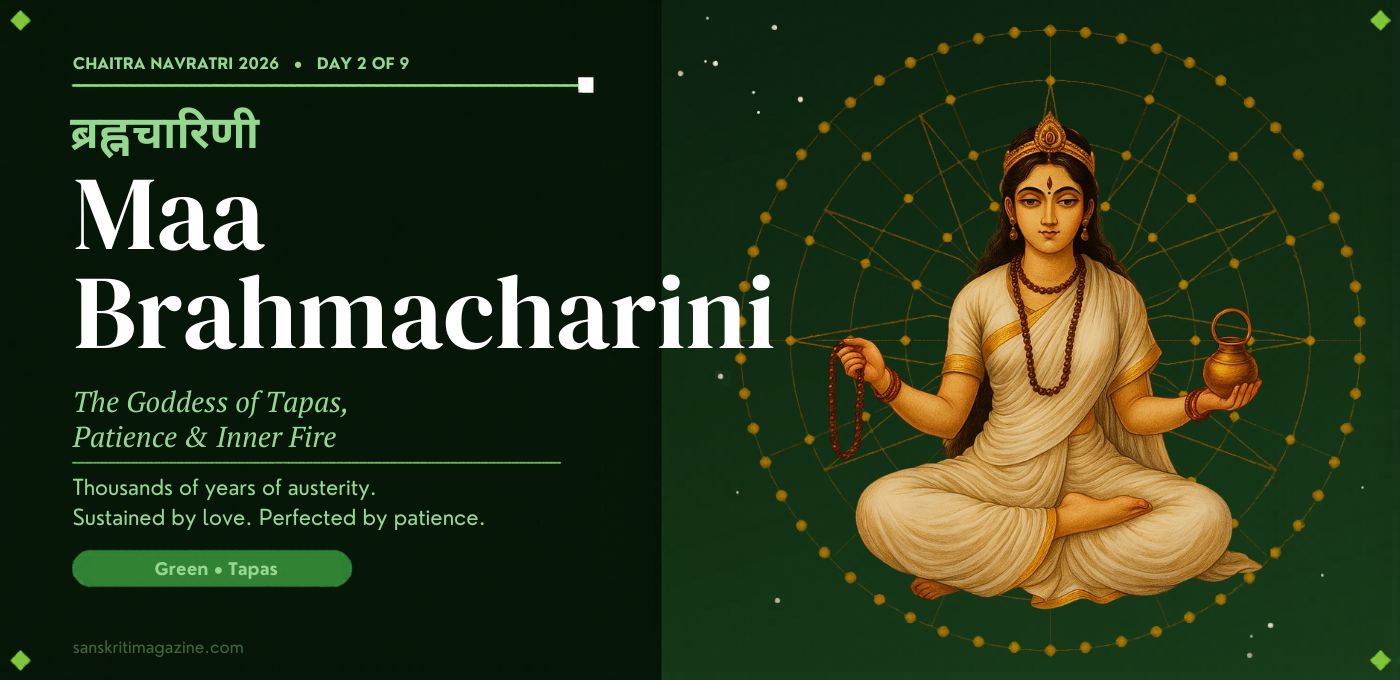
Continue the journey tomorrow: Day 2 — Maa Brahmacharini, the Goddess of Tapas and Unbreakable Inner Fire.