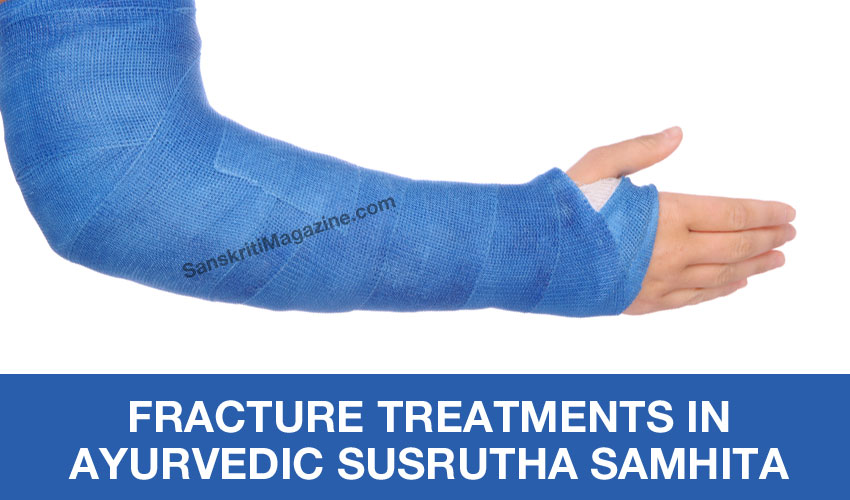
In traditional Ayurveda practice, the fracture of bones and their treatment was first mentioned in SUSRUTHA SAMHITA – Chikitsa Sthana from the view of surgical management. Among the different types of fractures, ancient Indian surgeons gave importance to the fractures of thigh, spines, shafts of long bones, and the pelvic region. The principles laid down by Sushruta are so relevant that they are even practised by today’s orthopaedic surgeons.
Those four basic principles in ancient fracture treatment are: Anchana, Peedana, Sankshepana, Bandhana (see fig. above).
Among the management of fractures is the Kushabandha (wooden splint) which is practised as an application of POP cast or slab (or squint bandage, as are used at present). In same way, the chakrayoga that is explained in Astanga Hrudaya is in vogue in the form of the traction method.
Here a comparison of ancient techniques is made with the modified techniques practiced in the present era. In traditional Indian medicine there is a explanation of about 6 types of dislocations, and 12 types of fractures.
6 types of dislocations are:
- Utpista – Fracture dislocation
- Vislista – Dislocations of joints due to ligamental tears
- Vivartita – Anterior-posterior dislocation of the head of the humerus
- Avakshipta – Downward displacement of the head of the humerus
- Atikshipta – Marked displacement of any articulation surface
- Tiryakshipta – Oblique dislocation in one of the articulating bones
12 types of Fractures are:
- Karkataka – Depressed fracture.
- Aswakarana – Complete oblique fracture.
- Churnitam – Comminuted fracture
- Pichhitam – Fracture by compression.
- Asthichallita – Sub periosteal avulsion.
- Kandabhagna– Complete spiral fracture.
- Majjanugatam– Impacted fracture.
- Atipatitam – Complete compound fracture.
- Vakra – Green stick fracture.
- Chinnam – Incomplete fracture.
- Patitam – Comminuted fracture flat bones.
- Sputita – Fissured fracture.
Traditional Indian medicine has mentioned different medicines, formulations, rejuvenators, and dietary restrictions for the rapid and complete healing of fractures. The few orthopaedic techniques are mentioned below :
KUSHA BANDHANA (Application of P.O.P.cast or splint)
Kusha bandhana is a technique that ancient Indian surgeons practiced for fracture immobilization. In this technique they have applied the barks certain plants like bamboo, banyan, and pipal which were referenced regarding external applications of pastes of bamboo pith, latex of banyan, and pipal like trees. This procedure was practiced based on the season, time, constitution, and strength, of an individual. While manipulating the broken bones, Unnamana (elevation of depressed fragment) and Vinamana (Depression of elevated fragment) were followed by traction and retention. In the winter season, the bandage should be changed once per week. In the rainy season, the bandage is to be changed once per five days. In the summer, the bandage has to be changed once per three days. The bandage should be in the form of SAMABANDHA (neither too tight nor too loose).
ASTHIPOORANA (Bone Grafting)
As per the classic version, in compound fractures, multiple fractures, and irregular fractures where the fractured part is totally separated or missed in those conditions, one has to fill the missing part by Sudha varga dravyas (materials possessing mineral calcium). The paste prepared from the combination of Sudhavarga dravya, decoction of Rubia cordifolia, and latex of the banyan tree was used as a graft material. After the filing up the area, medicated oils are applied for proper acceptance and healing of the bone.
CHAKRAYOGA (Skeletal Traction)
In long bone fractures, the fractures of the shaft, hairline fractures, oblique fractures, and in compound open fractures, there is the reference of using of Chakrayoga. As per the reference, in dislocation of joints, skin traction was practiced.
KAPTASHAYANA (Fracture Bed) VIDHI
This method of immobilization is used in the fracture or dislocation of the thigh, hips, ankle, shoulder, spine, spinal column, bones of thorax, and axillary regions. In this method, the patient was laid on a multi-holed bed where the affected part is immobilized using five wooden pegs. The method of preparing and fixing of an artificial limb is also mentioned in the ancient traditional medicine of India. These are used in practice by changing the type of and quality of a material in a sophisticated manner.
In ancient days artificial limbs were prepared with bark of bamboo, by the mixture of wax, mud, thin bamboo bark, and grass. In modern times, however, artificial limbs are prepared with solid and smooth woods like teak, rosewood, and with adhesive cement. In ancient days deformities like scoliosis or kyphosis in spinal column, a jacket or a belt that is made up of leather material was used to fix the problem. In the modern era the same type and structured belt is also used but it is made up of leather-chromium-ion jacket.